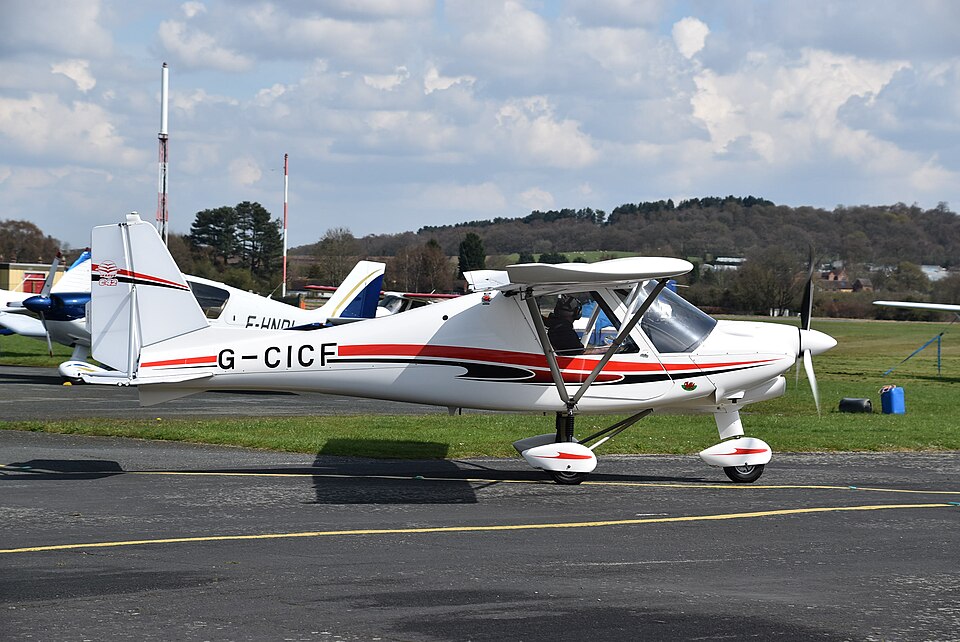
History of the Flight
The pilot, accompanied by an instructor as passenger, intended a short local flight to maintain currency. After a normal pre-flight, engine start, and checks, the aircraft took off from Runway 28 Left at Headcorn Aerodrome, climbing to 1,300 ft before turning south. Shortly after the turn, both occupants observed smoke in the cabin. The pilot switched the battery master to OFF, but smoke continued. The pilot positioned for a downwind landing while the passenger opened the upward-opening cabin door a few inches, allowing smoke to be sucked outside. The aircraft landed downwind and stopped; the pilot shut down the engine, and both occupants left. Airfield RFFS discharged two CO2 extinguishers onto the still-burning battery and removed it.
Aircraft and Battery Information
The Ikarus C42 is a two-seat high-wing microlight with fixed tricycle gear. G-CICF was factory-built and operated on a BMAA Permit-to-Fly. The main battery, originally a sealed lead-acid, was replaced in October 2016 with a LiFePO4 lithium-ion battery (Super B SB12V5200P-BC) via a BMAA Minor Modification (TIL 117). The battery was secured in a box mounted on the main fuselage tube between the seats, open at the top with no containment or venting. The charging circuit lacked a separate over-voltage protection (OVP) device. The modification required a battery master switch and a voltmeter marked for overcharge condition. The battery had accumulated 1,338 hours since installation with no prior problems.
Investigation Findings
The investigation did not identify the cause of the battery fire. The battery's location in the cabin exposed occupants to hazards, as the battery box did not contain combustion products or heat. A similar airborne battery fire to the same aircraft type and lithium-ion battery occurred in Germany, resulting in aircraft destruction. The manufacturer, Comco Ikarus GmbH, issued Service Bulletin SB-42-020-2017 in May 2017 requiring an OVP for C42s with lithium-ion main batteries. However, the UK A8-1 approval holder did not assess this bulletin, so no requirement existed for UK-registered C42s, including G-CICF. The investigation was unable to determine if the battery had been subjected to jump starting, overcharging, or excessive discharging. The battery manufacturer stated jump starting or excessive discharging as most likely causes for failure and thermal runaway.
Safety Recommendation
One Safety Recommendation was made to review installation requirements of lithium-ion main batteries in cabin areas of Non-Part 21 aircraft to minimize effects on occupants during a battery fire.