History of the Flight
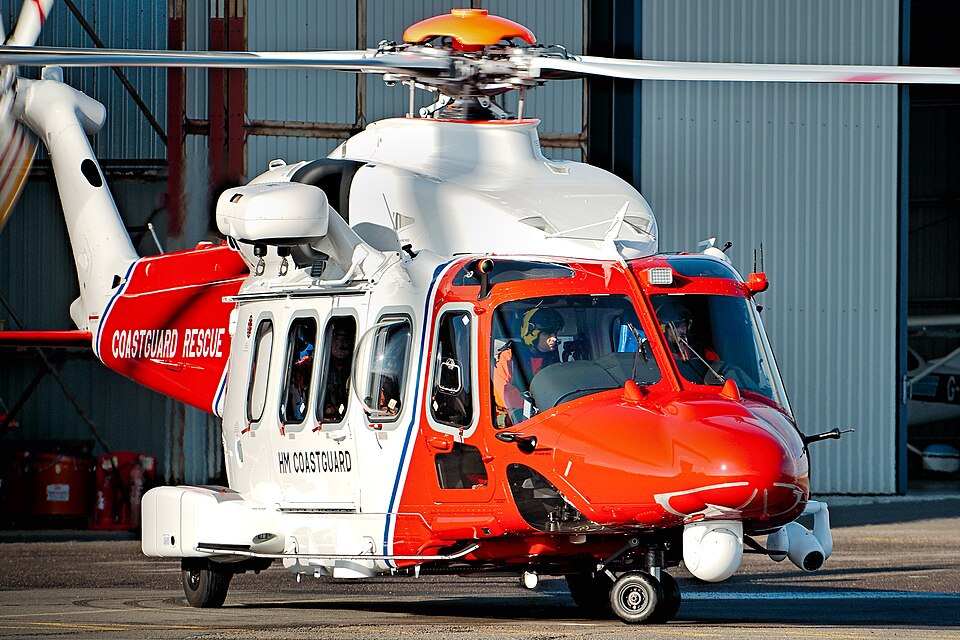
After completing a SAR training sortie involving winching operations at Porthcawl, the Leonardo AW189 (G-MCGU) transitioned to forward flight to return to its base at St Athan. The cabin and cockpit heating was selected on and the vents opened. Approximately two minutes later, the flight crew observed light-green foam debris in the cockpit, primarily from vents under the windscreen and adjustable vents on the left side. They turned the heating off but detected a burning smell and decided to land, selecting a field near a road.
A PAN call to Cardiff Radar was acknowledged. About 30–45 seconds later, when the aircraft was approximately 100 ft agl, smoke was seen from vents under the windscreen, described as "whisps at first, followed by thicker grey smoke." The crew made a MAYDAY call; the transmission was received but the response was not heard due to low altitude. The aircraft landed without further incident. The rear crew vacated, doors were opened for ventilation, and engines were shut down. Local RFFS attended with Police about 20 minutes later, surveying with a thermal camera that showed no signs of fire.
Company engineers later inspected the aircraft and heating system with no additional findings. After isolating the heating system, the aircraft was ground run for 10 minutes with no recurrence of smoke. It then hovered for two minutes and flew back to St Athan, landing seven minutes later. During that flight, the crew noted a slight smell of burnt material but no smoke.
Aircraft Examination
Inspection by the operator’s engineers revealed that a heating duct in the right-hand rear fuselage had collapsed and its external insulation was missing from a large section. The cockpit fans and two auto-transformer rectifier units (ATRUs) with integral cooling fans, mounted close to the failed duct, had ingested duct insulation material. The duct failure occurred at 1,399 flight hours since new.
Subsequent Event
On 17 April 2021, another of the operator’s AW189s (G-MCGT, 1,522 flight hours) experienced a heating duct failure when the heating was selected on at the end of a SAR sortie. Inhalation of particles and debris was unavoidable, and all crew members experienced respiratory irritation.
Fleet Inspection
Following the failure on G-MCGU, the operator issued a Technical Directive requiring a one-time inspection of the heating duct on all its AW189s within 50 flight hours. The inspection included visual examination of the duct’s external surface, cabin floor heating outlets, and (depending on configuration) cockpit fan inlet for evidence of insulation fibers. It also involved operating the heating system to check for anomalies or unusual odor. This inspection was performed on G-MCGT on 14 March 2021 with no findings, 31 flight hours before its duct failure. The inspection did not require removal of duct insulation material.
Previous Events
Prior to the duct failure on G-MCGU, the operator had experienced heating duct failures on two other AW189s: G-OENC at 1,077 flight hours on 26 October 2018, and G-MCGN at 851 flight hours on 3 December 2019. Neither event resulted in a precautionary landing.
Component Examination
The failed ducts from G-MCGU and G-MCGT were sent to the manufacturer’s laboratory. The manufacturer analyzed the morphology of bonding surfaces, comparing failed joints (highlighted by red ellipses in figures) to intact joints (blue ellipses). On failed joints and those manually separated, adhesive was generally present only on internal surfaces of flexible sections; traces on outer surfaces of rigid bend sections appeared to be adhesive squeezed out during assembly.
The rigid bends are fabricated from composite fiber bundles in a criss-cross pattern, impregnated with resin. The surfaces were not uniformly smooth; some areas had voids between fiber bundles while others had resin-filled voids. Several characteristics were observed on the adhesive bonding surface: cubic-shaped reliefs (from adhesive penetration into voids), well-defined or slight imprints of crossed fiber bundles, and bubbles of various sizes.
On intact joints, a greater proportion of the bonding surface showed cubic-shaped reliefs and well-defined fiber imprints. On failed joints, cubic-shaped reliefs were almost absent, and a greater proportion showed slight fiber imprints and bubbles. The manufacturer considered that cubic-shaped reliefs indicate mechanical interlocking that positively affects adhesion, but because the rigid bend surface was not uniform, this morphology could not be achieved across the entire bonding surface. The definition of fiber imprints varied according to local mating pressure; in areas with well-defined imprints, some fiber bundles detached with the adhesive, suggesting effective adhesion, whereas areas with less defined imprints likely had weak adhesion. Bubbles may have been caused by relative movement during bonding prior to sealant solidification, due to loss of applied mating pressure. The thin films of adhesive in bubble areas, combined with the observed characteristics, contributed to the failures.
Probable Cause
The investigation determined that the heating ducts failed due to non-uniform adhesion at joints between rigid and flexible sections of duct.