Incident Overview
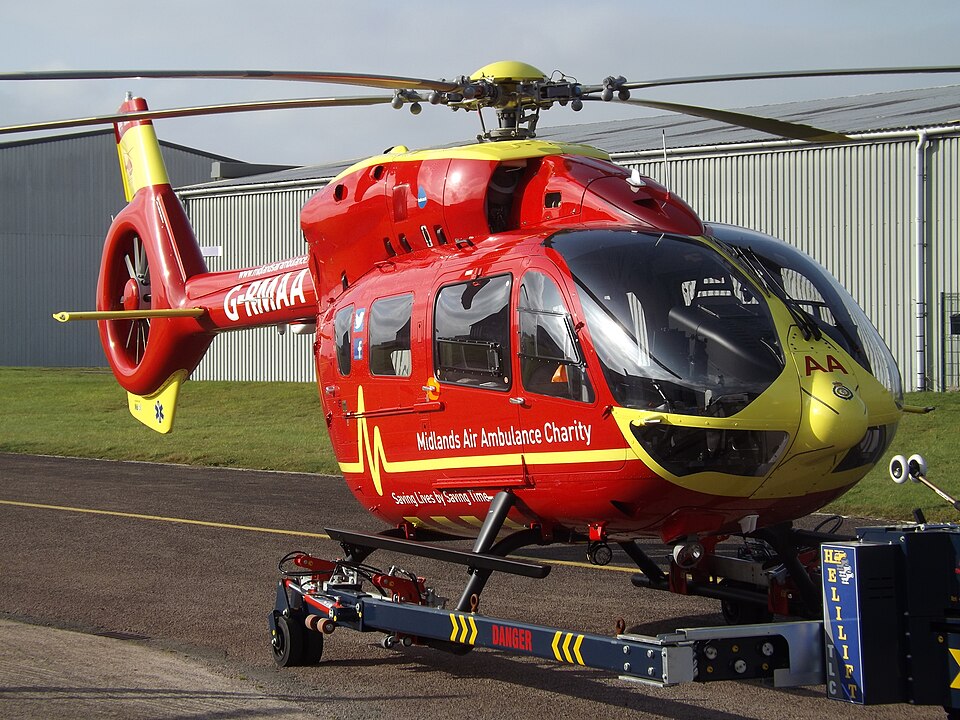
On 3 May 2018 at 1400 UTC, a MBB-BK 117 D-2 EC145 helicopter, registered G-RMAA, was involved in an accident during takeoff from a car park near Molineux Stadium in Wolverhampton, West Midlands. The helicopter was being operated as a Commercial Air Transport Helicopter Emergency Medical Service (HEMS) flight. On board were one crew member and three passengers; none were injured. The aircraft sustained damage to the frangible fenestron protector and a distorted undercarriage cross tube.
Pilot and Experience
The commander, aged 45, held an Airline Transport Pilot’s Licence and had accumulated 2,012 total flying hours, of which 54 were on the EC145 type. In the last 90 days he had flown 48 hours, and 20 hours in the last 28 days.
Sequence of Events
The pilot had landed the helicopter in the car park to prepare for transporting a patient to Queen Elizabeth Hospital in Birmingham. Before restarting the engines, he assessed the wind and determined it to be predominantly east to south-east, variable in the car park area. He had landed into the wind and did not plan to turn during departure.
After loading the patient and starting the engines, the paramedic boarded. The pilot completed pre-takeoff checks with no abnormalities, engines set to flight, and autopilot engaged. He raised the collective slowly with anti-torque pedals level and brought the helicopter into a low hover. As the helicopter became light on its skids, it began to yaw to the left. The pilot applied opposite anti-torque pedal to counteract, but the yaw continued. He decided to land and rapidly lowered the collective.
The helicopter turned approximately 40° to the left from its original position and moved 3 to 4 ft rearwards. The frangible section of the tail boom contacted a low wall, and the landing gear cross tube deformed due to the heavy landing. The pilot shut down the aircraft, and occupants vacated; the patient was transported by road ambulance.
Technical Examination
Subsequent examination by the operator’s maintenance organisation found no technical issue that could have caused the loss of directional control.
Flight Data and Witness Video
A review of flight data and a video from an onlooker showed that the left anti-torque pedal was slightly depressed prior to lift-off and remained in that position as the helicopter lifted but stayed in ground contact. Once airborne, it yawed left. The pilot applied right anti-torque pedal, but it was insufficient to arrest the yaw rate.
Pilot’s Comments
The pilot, who had recently transferred from flying the EC135 to the EC145, noted that when confronted with variable wind conditions, he made anti-torque pedal inputs consistent with controlling an EC135, which were insufficient for the EC145 in this instance.
Landing Site Assessment
The operator assessed the landing site against EASA regulations and their operational procedures for HEMS operating sites. The site was compliant with EASA AMC1 SPA.HEMS.125(b)(4) and OM A HEMS requirements. However, an Operations Department Communication (ODC) providing more detailed guidance to pilots had not been updated with the most recent EASA Acceptable Means of Compliance reference and did not directly state the dimensions of the EC145. While this update would not have resulted in a different landing site, it provides clarity for future site selection.
Safety Actions
As a result of this event, the operator re-briefed all its pilots on the possible consequences of remaining light on the skids when lifting into a hover. The operator also updated their ODC to reflect the most recent EASA Acceptable Means of Compliance and to refer to dimensions of both the EC135 and the EC145.