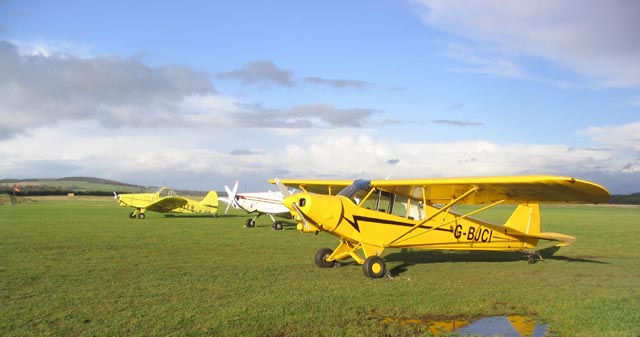
History of the Flight
On 17 September 2015, a pilot (Pilot A) prepared to conduct glider aerotows using G-BJCI, a Piper PA-18-150 Super Cub. After completing the daily inspection with no discrepancies, he started the engine, which immediately ran up to a higher power than expected. Closing the throttle did not reduce the rpm, and despite applying heel brakes, the aircraft began moving toward a car parked approximately 20 ft away. Attempting to turn left to avoid the car, Pilot A heard a strike and subsequently shut down the engine. Inspection revealed damage to the right elevator and a rear light lens of the car.
The previous morning, a different pilot (Pilot B) had experienced a similar uncommanded full power event during pre-takeoff checks. He shut down the engine and had the aircraft pushed back to the hangar. Later, after being informed the aircraft was ready, Pilot B successfully completed a test circuit and seven aerotows before lunch. After lunch, during a glider tow to 2,500 ft, immediately after release, the engine again ran uncommanded to full power. He shut down the engine, made a successful glide approach and landing, and reported the problem to the club safety officer and the tugmaster.
Discussion
A licensed technician who assessed the damage noted that the reported engine behaviour was consistent with a known problem: a loose clamp on the throttle cable can allow the cable outer to move, and a spring on the throttle, intended as a fail-safe, then drives the throttle to fully open. The technician tightened the clamp but did not run the engine to confirm the fix. It is not known who informed Pilot B that the aircraft was ready for a test after the first occurrence or what actions were taken.
Pilot A, reporting as duty tug pilot, was unaware of the previous day's events or believed the defect had been rectified. The club did not keep technical logs for its tugs, although a system for passing information between pilots existed but apparently was not used. The British Gliding Association's Chief Technical Officer visited the club to assist with preventive measures, including restricting airside vehicle access and introducing chocks at refuelling and start-up points.
A general perception existed that the Super Cub's brakes could not hold the aircraft against full power, though this is considered a misconception if brakes are properly maintained.