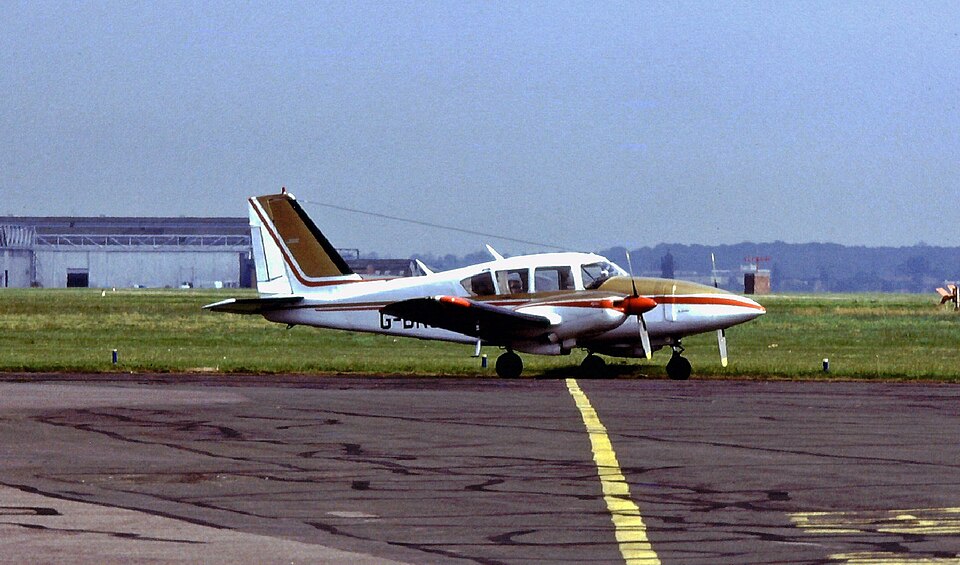
History of the Flight
The pilot arrived at Bagby Airfield at approximately 0800 hrs on 6 July 2023. He first delivered a Cessna 310 to Leeds East Airport before returning to Bagby. He then prepared to fly G-BKJW to Deauville, France, to collect five passengers and transport them to Abbeyshrule, Ireland. After dropping off the passengers, he flew to Navan airfield to collect a spare part, then departed for Bagby. The aircraft was refuelled multiple times. The pilot made a normal radio call to Bagby at about 1842 hrs, reporting he was four miles out and would join right base for Runway 06. Witnesses saw the aircraft suddenly pitch nose-down from about 1,000 ft, wings-level, and dive to the ground. The aircraft struck trees and then the ground at an angle of 35° to 40° nose-down, with no indication of recovery. A post-impact fire ensued, and the pilot was fatally injured.
Recorded Information
Radar data from NATS and the PilotAware network covered most of the flight within UK airspace. The final radar return at 18:43:52 showed the aircraft at 740 ft amsl, 875 m from the accident site. Descent rate analysis indicated a sharp increase to 1,800 ft/min, a brief reduction to 1,000 ft/min, then another increase. CCTV video from Bagby airfield captured the aircraft's final descent, showing a steep nose-down trajectory. Groundspeed calculations from CCTV gave approximately 122 kt, with airspeed around 112 kt accounting for wind.
Accident Site and Wreckage Examination
The accident site was 1.0 nm southwest of the Runway 06 threshold. The aircraft struck trees in a steep nose-down attitude before hitting the ground and catching fire. The wreckage spread was about 47 m, with the pilot's body found 34 m beyond the fuselage remains. The tail section was relatively intact; the horizontal stabilator was free to move with connected control cables. The pitch trim drum was found 3 mm from the full nose-down position. Pre-impact flap and landing gear positions could not be determined. Flight trials on a similar aircraft showed that this trim position was more nose-down than expected for any flap configuration at the estimated speeds. However, the trim could have moved during the post-impact break-up.
Probable Cause
The investigation considered several causes for the nose-dive. A pitch trim runaway was considered the most likely, but there was insufficient evidence to determine it as the definitive cause. The CAA has planned eight safety actions related to pitch trim runaway training, autopilot deactivation, circuit breaker visibility, and differences training requirements.