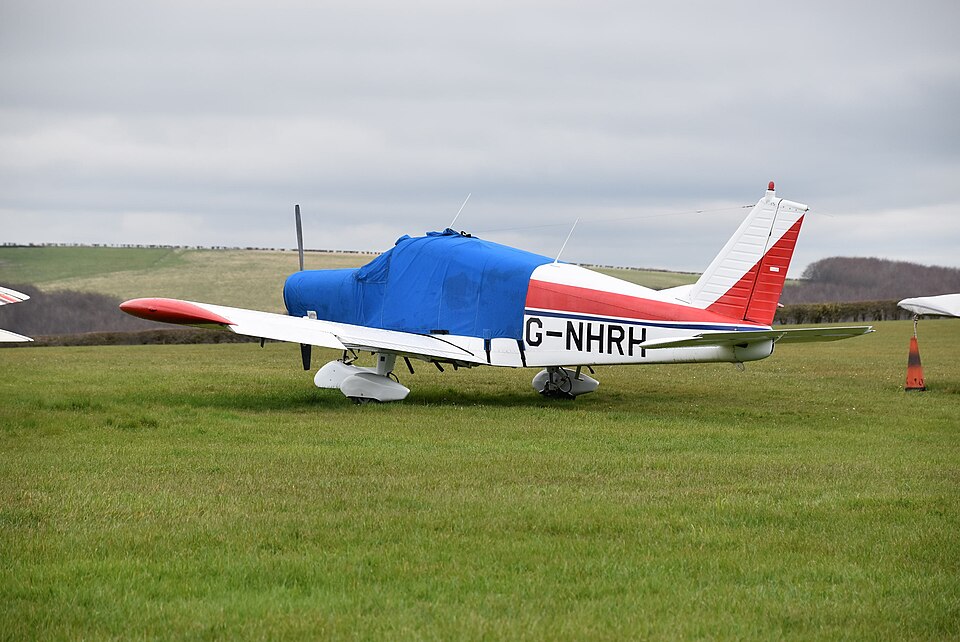
History of the Flight
On 30 May 2016, a Piper PA-28-140 Cherokee, registration G-NHRH, was operated on a private flight from Compton Abbas Airfield, Dorset, to Dunkeswell Airfield, Devon, with one passenger on board. During the approach to Dunkeswell, the pilot performed a go-around due to observed parachuting activity but subsequently landed without incident. After parking for several hours, the pilot flew the aircraft back to Compton Abbas with the same passenger.
Upon returning, the pilot made a straight-in approach to grass Runway 08, which was dry. The runway has an available landing distance of 803 m and slopes down from the threshold toward the midpoint before rising toward the opposite threshold. The wind was northeasterly at 20 kt, and the pilot approached at 75 kt, which he stated was faster than normal due to the wind strength. He indicated that the approach was otherwise unremarkable, but he touched down more than halfway along the runway. The landing was heavier than intended; shortly after touchdown, the pilot and passenger felt a jolt and were jerked against their seatbelts. The nose landing gear collapsed, and both propeller blades struck the ground. The aircraft came to a stop in a nose-down attitude, and both occupants vacated without injury or assistance.
Witness Information
A witness at Dunkeswell observed the aircraft's arrival and noted that all three wheels contacted the runway simultaneously in what was described as a hard landing, though no obvious damage occurred. At Compton Abbas, an official reported that the airfield remained open later than usual to accommodate the aircraft's return. An experienced PA-28 pilot, who watched the approach, judged the aircraft to be higher than expected when it crossed the threshold, estimating its height at 100 ft agl. This witness stated that the pilot did not appear to flare the aircraft before it contacted the ground in a nose-down attitude, approximately 500 m from the start of the runway. The nose landing gear seemed to collapse immediately, and the aircraft continued along the grass runway for 64 m before coming to rest, pointing 45° left of the runway centerline, still in a nose-down attitude.
Aircraft Damage
The nose landing gear assembly collapsed; the nosewheel detached and one leg of the fork assembly broke off, with the other fork bent through approximately 60°. Both propeller blades were bent, and the engine was pushed back and upward, causing distortion of the engine mounting.
Pilot Experience
The pilot, aged 70, held a National Private Pilot's Licence and had a total flying experience of 190 hours, of which 132 hours were on the PA-28 type. In the 90 days preceding the accident, he had flown 3 hours; in the last 28 days, 1 hour. His logbook showed he began flying training in 1990 and was issued an NPPL(A) in November 2012. Since that date, he had recorded 16 hours of flying, all in his own PA-28, including one flight with an instructor on 9 November 2014 for renewal of his SSEA (land) rating. He recorded no flying time from March 2013 to August 2014 or from November 2014 to April 2016. From 8 April 2016 until the accident flight, he flew four times and logged three hours.
AAIB Comment
The AAIB referenced CAA Safety Sense Leaflet 1e 'Good Airmanship,' which advises general aviation pilots to revise their basic knowledge and skills by having a regular flight with an instructor at least every year. The leaflet also recommends planning to touch down at the correct speed and close to the runway threshold, and to go-around if not solidly on the ground in the first third of the runway (or first quarter on wet grass).