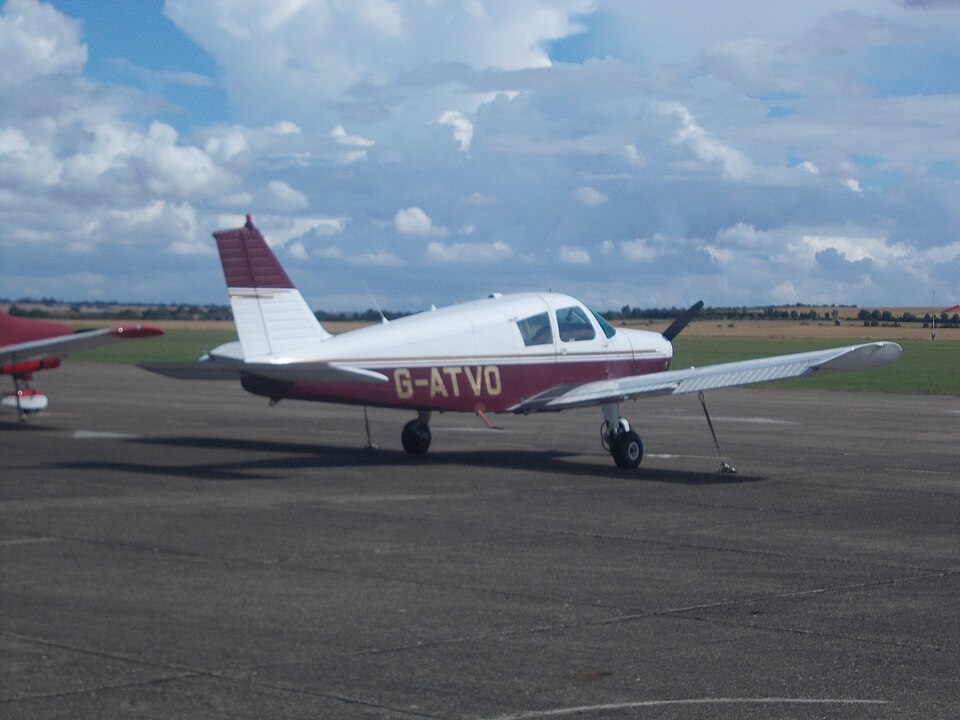
Accident Overview
On 30 March 2017 at 1450 UTC, a Piper PA-28-140, registration G-ATVO, was involved in an accident at Shoreham-by-Sea, West Sussex. The aircraft was on a training flight to convert a PPL(A) holder to the type. The crew comprised two pilots; no passengers were on board. Both crew members evacuated without injury. The aircraft sustained damage from submersion in seawater.
Flight Details
The flight was the first of the day. The aircraft had been refueled the previous day to the internal 'tabs' on both wing tanks, providing sufficient fuel for over three hours of flight. The PPL(A) holder conducted the daily check, draining fuel samples from both wing tanks and the firewall gascolator; all samples appeared as blue AVGAS with no visible water. The left fuel tank was used for engine start and taxi, then switched to the right tank for engine run-up and pre-takeoff checks, which were normal. The commander requested a short-field takeoff configuration with two stages of flap. After lining up on Runway 20, full power was applied; static propeller rpm was 2,400. The takeoff and initial climb were normal, with flaps retracted one stage at approximately 350 ft. While climbing through 450 ft, the engine abruptly lost power, though the propeller continued to windmill.
Ditching and Aftermath
The handling pilot passed control to the commander, who lowered the nose to maintain best glide speed and turned left towards the shoreline. The commander confirmed fuel selection to the right tank, magnetos set to both, primer locked, and electric fuel pump on. Throttle pumping did not restore power. Realizing a ditching was inevitable, the commander turned right to track parallel to the shore, selected two stages of flap, opened the cabin door, and transmitted a MAYDAY to Shoreham ATC. The sea was calm with a slight swell; the aircraft ditched approximately 10 m from the shore. Both crew exited without difficulty and swam to shore. The aircraft subsequently sank but was later recovered with no significant damage other than seawater immersion.
Aircraft Examination
After recovery, the aircraft's fuel system was contaminated by seawater, preventing reliable fuel sampling. The fuel selector valve was found selected to the right wing tank. No fuel leaks or obstructions were found in tanks, vents, filters, lines, gascolator, or pumps. The carburettor had no defects; the accelerator pump functioned normally. The mechanical fuel pump tested normally. The engine was disassembled at an overhaul facility; it had 1,126 hours since last overhaul. No failures that could explain an abrupt power loss were found, though significant wear was noted on camshaft lobes 2, 5, and 6, and corresponding tappet faces. The engine's oil filter had been lost during dismantling and was unavailable for inspection. The exhaust system had no blockages. Magnetos and ignition harness could not be functionally tested due to seawater contamination.
Meteorological Conditions
Weather at the time: no cloud below 5,000 ft, visibility >10 km, wind from 120°M at 10 kt, temperature 15°C, dew point 10°C. The CAA carburettor icing chart indicated a serious risk of carburettor icing at all power settings.
Additional Tests
The AAIB conducted a ground test using a PA-28-161 Warrior (marginally more powerful engine). With the fuel selector moved to OFF, the engine ran for 44 seconds before stopping. The volume of fuel in the line between the selector and the right tank was estimated at 0.136 litres, providing about 16 seconds of full-power operation. Thus, if contaminated fuel entered from the right tank, approximately one minute could elapse before power loss occurred.
Investigation Outcome
The cause of the abrupt engine power loss during the takeoff was not established.