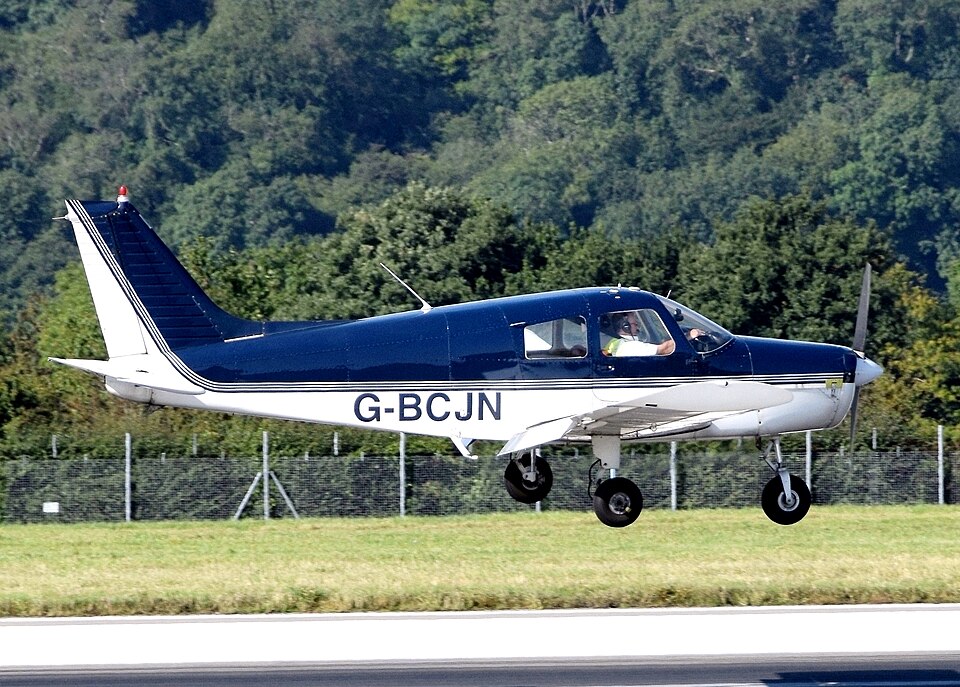
Synopsis
On 4 August 2022, at approximately 0935 UTC, a Piper PA-28-140 (registration G-BCJN) was conducting circuit training at Cotswold Airport, Gloucestershire. During an attempted go-around, the aircraft veered left from the runway, touched down beside the runway, passed between two parked airliners, and struck the nose landing gear of one with its right wing tip. The wing was severed, and the aircraft continued across grass, through the perimeter fence, over the A429 road, and came to rest in a ditch. Both the instructor and student sustained minor injuries.
History of the Flight
The flight was a circuit training detail for a PPL student. The instructor and student had flown together previously. The planned circuit training at the operator’s base (Bristol Airport) was not available due to high traffic, so Cotswold Airport was selected. The plan was to transit to Cotswold, join the circuit, perform one powered approach, and then move to glide circuits.
During the takeoff from Runway 27 at 0851 hrs, the student rotated at 52 kt instead of 60 kt and struggled with speed control during climb. During the overhead join, the student flew about 300 ft below the intended altitude. The instructor took control and executed a go-around when the student positioned too close behind another circuit aircraft. After repositioning, the student conducted a powered approach but allowed airspeed to become too low, leading the instructor to take control for a touch-and-go. A subsequent approach was successful with some instructor assistance.
On the third approach, the instructor left more workload to the student. The student began right of the centreline and “snaked” left and right. The aircraft was initially too high, then descended below the approach path. After adding power, the airspeed reduced as the aircraft pitched up. At about 300 ft agl and left of centreline, the instructor decided to go around.
Accident Sequence
CCTV showed the aircraft touched down near the runway threshold, turned sharply left, and became airborne again. It climbed to only about 20 ft agl while continuing to turn left. The aircraft passed over a fence about 100 m left of the runway and headed toward parked airliners on Taxiway C. It descended, passed under an Airbus A319 wing, and touched down between the A319 and an Airbus A321. The right wing tip struck the A321’s nose landing gear, severing the outboard right wing. The aircraft continued across grass, through the perimeter fence, and crossed the A429 road. It struck trees and came to rest in a ditch. No cars were on the road during the crossing.
Pilot Recollections
The instructor stated he called “I have control” at about 100 ft agl, applied full power, and retracted flaps to 25°. Airspeed was about 60 kt (approach speed was 70 kt). The aircraft pitched up more than expected and rolled left. The instructor noticed the student was still making control inputs and used explicit language to encourage the student to release control. The instructor did not recall the student saying “you have control.” The instructor noted the nose-up attitude above level flight with 10–15° left bank, speed between 50 and 60 kt. He could not explain the lack of climb.
The student recalled the nose being “steeply up” and seeing parked airliners ahead, but no further recollection until the aircraft stopped.
Recorded Information
The aircraft had no flight data recorder. A mobile phone app stopped tracking before the accident. Airfield CCTV captured the approach, landing, and go-around but suffered from pixelation and compression. Photogrammetry provided flight path and ground speed with some errors. CCTV from a nearby business showed the final touchdown, impact with the parked aircraft, and road crossing.
Aircraft Information
G-BCJN was a 48-year-old Piper PA-28-140 with a Lycoming O-320-E3D engine. It had a four-seat low-wing design with tricycle landing gear. The airspeed indicator had two concentric scales: mph on the outer and knots on the inner. The student had flown this aircraft three times before and had difficulty with speed control, previously focusing on the outer scale and using speeds too low.
Examination
Post-accident examination found no pre-existing defects that would have affected normal performance. The aircraft was economically damaged beyond repair.