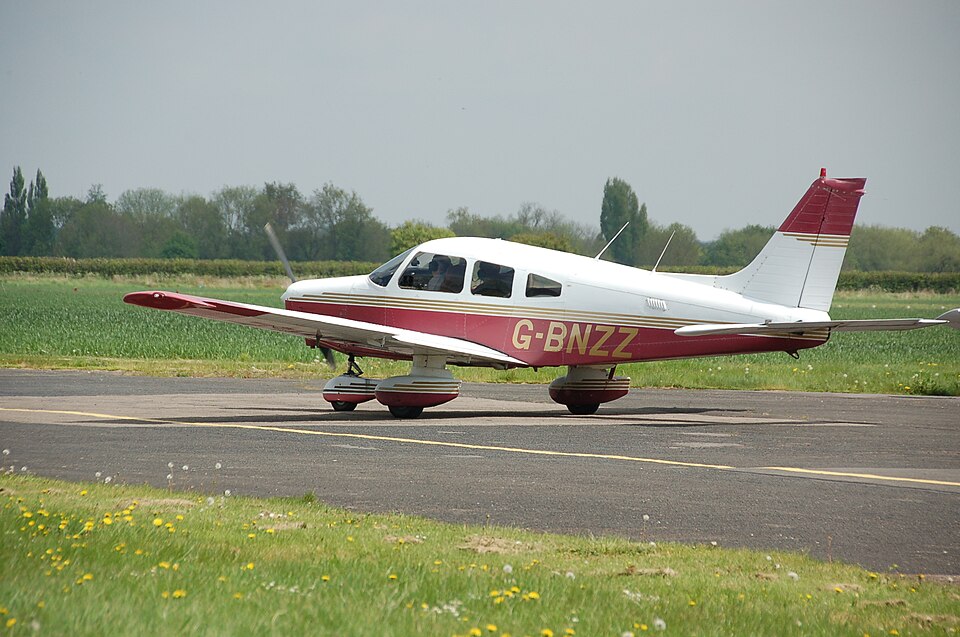
Accident
On 19 June 2017 at 1050 hrs, a Piper PA-28-161 Cherokee Warrior II, registration G-BNZZ, was involved in an accident at East Kirkby Airfield, Lincolnshire. The flight was a private flight with one pilot and one passenger onboard; both were uninjured. The aircraft sustained damage to its landing gear and structure.
Sequence of Events
East Kirkby is an unlicensed airfield located within the Coningsby Military Aerodrome Traffic Zone. The airfield features an unmarked landing strip comprising both grass and concrete surfaces. Online advice recommends that the concrete surface be used only for emergency run-off and that landing should be conducted entirely on the grass.
After being cleared by Air Traffic Control to descend at his discretion, the pilot noted that he was slightly north of the extended runway centerline. He corrected his course and observed a vehicle turning away from him on the concrete at the far end of the runway. Upon touchdown, the pilot sensed that the distance available would be tight, but decided against performing a touch-and-go due to reduced climb performance caused by high ambient temperature and the proximity of personnel and vehicles. Unable to stop on the grass, the aircraft struck a raised kerb at the transition between the grass and concrete, resulting in damage.
Cause
The pilot attributed the accident to a combination of a high approach and landing long and to the left of the unmarked strip, and also commented that the airfield plate was ambiguous.