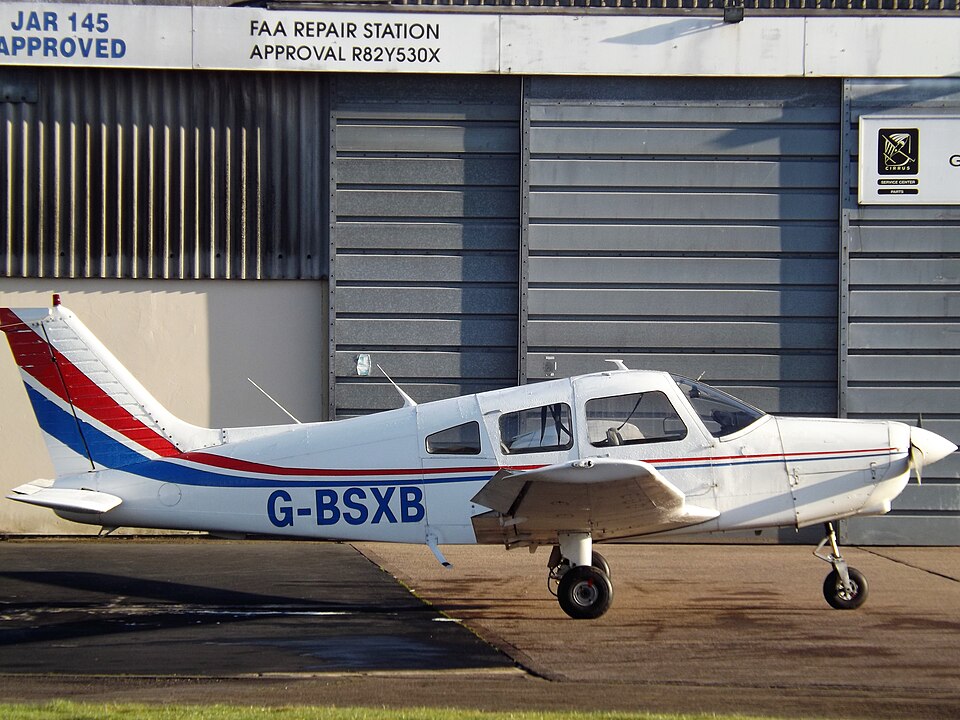
History of the Flight
On 16 November 2017, a Piper PA-28-161 Cherokee Warrior II, registration G-BSXB, was operated as a private flight from Wolverhampton (Halfpenny Green) Airport. The pilot was aware of a cold weather front approaching from the northwest. Before departure, the Flight Information Service Officer (FISO) reported the wind as estimated from 230° at 8 kt, based on a windsock due to an unserviceable anemometer. The aircraft departed from asphalt Runway 16.
After leaving the circuit, the pilot encountered deteriorating weather including low cloud, rain, reduced visibility, and turbulence. Approximately 20 minutes later, he informed the FISO of his intention to return and was advised that Runway 16 remained in use.
Landing and Accident
The pilot re-joined the circuit for Runway 16, which has a landing distance available of 858 m. He reported on the downwind leg, and the FISO acknowledged. Less than two minutes later, the FISO observed the wind had veered and called the aircraft. The pilot announced he was on final approach; the FISO then estimated the wind as from 300° at 10 kt, creating a tailwind. The FISO spotted the aircraft at approximately 10 ft above aerodrome level, more than halfway along the runway, and watched as it touched down adjacent to the Precision Approach Path Indicators for Runway 34, located 393 m from the stop-end of Runway 16.
According to the pilot, the aircraft seemed reluctant to descend on final, and he did not recall hearing the tailwind warning. Visibility was reduced by rain. Despite being more than halfway along the runway while still airborne, he continued the landing, believing sufficient runway remained. His passenger, a former flight instructor, twice suggested a go-around.
After touchdown, the pilot had difficulty decelerating due to the wet surface and tailwind. Realizing the runway end was approaching, he increased power and attempted to go around. Once airborne, the left wing dipped, possibly due to insufficient right rudder to counter increased engine torque. The left wingtip struck the airfield boundary hedge, causing the aircraft to lose height as it crossed a public road. It then impacted a second hedge with a co-located fence on the south side of the road. The left wing detached, and the aircraft spun around, stopping abruptly a few metres into a grass field.
Rescue and Post-Accident Observations
The FISO activated the crash alarm when the aircraft was about 100 m from the runway stop-end. He observed the aircraft adopt a nose-up attitude, cross the 46 m grass area beyond the runway, strike the boundary hedge (approximately two metres high), and disappear from view.
Upon arrival of the airfield Rescue and Fire Fighting Service (RFFS), the pilot and passenger were exiting the aircraft, but both required treatment for minor head injuries. The RFFS noted that the magneto key had been removed, but the electric master switch and fuel pump were on, and the throttle was at its maximum open setting; these controls were made safe.
Meteorological Conditions
The Met Office forecast indicated a cold front moving southeast across the British Isles, with isolated and embedded cumulonimbus clouds, expected to pass over the Wolverhampton area during the late morning. The Birmingham Airport Terminal Aerodrome Forecast suggested a wind shift from southwesterly to northwesterly between 1100 and 1300 UTC, with possible temporary reductions in visibility and cloudbase, associated rain, and gusts up to 25 kt.
A senior flight instructor at Wolverhampton noted deteriorating weather at the time of departure: darkening sky and drizzle. Later, after the crash alarm, he observed rain and estimated the wind from 340° at 15 kt. The sky cleared a few minutes later. He commented that the windsock position might make it difficult for a pilot on approach to Runway 16 to discern the reciprocal wind direction.
A helicopter instructor flying nearby was aware of the wind changing quickly from southwesterly to northwesterly, with an increase in strength, attributed to a weather cell west of the airfield.
Additional Information
The AAIB provided general references to the CAA's 'Skyway Code' (CAP 1535) on pre-flight preparation and interpretation of weather information, and to the UK Aeronautical Information Circular 84/2008 regarding low-altitude windshear. CAA Safety Sense Leaflet 1e 'Good Airmanship' includes advice to obtain an aviation weather forecast and to go-around if not solidly on in the first third of the runway, or first quarter on wet grass.