Accident
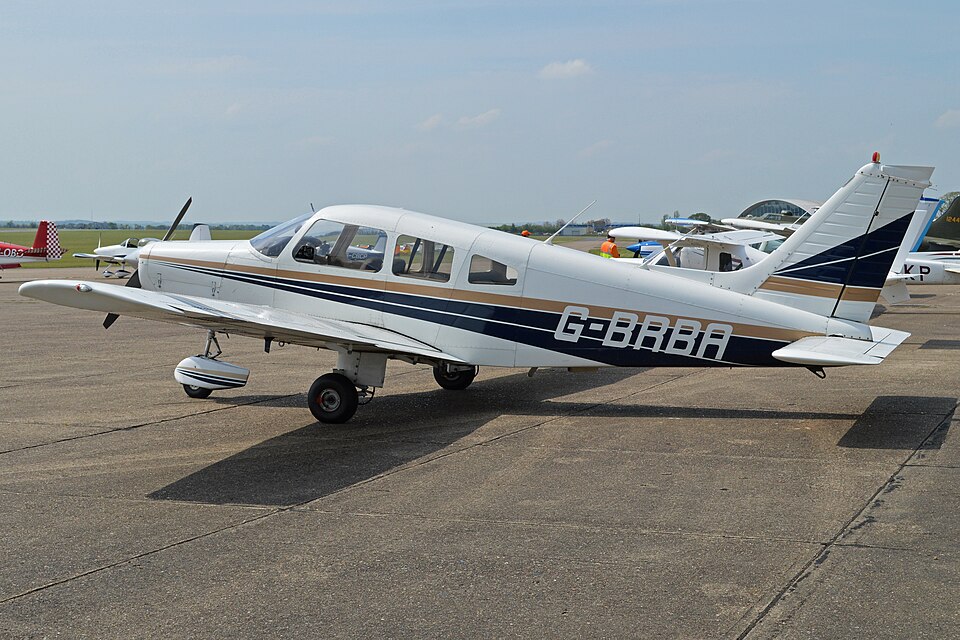
On 4 September 2021 at 1110 UTC, a Piper PA-28-161 (registration G-BRBA) was on a training flight at Wycombe Air Park, Buckinghamshire. The aircraft was operated by a flying instructor (aged 56, holding a Commercial Pilot’s Licence with 1,287 hours total, 998 on type) and a student pilot. The instructor was flying the aircraft. The flight departed from Runway 06L at 1100 hrs, with the takeoff, climb, and downwind leg appearing normal.
During the base leg, the instructor selected two stages of flap and reduced speed to 75 kt. At that point, the aircraft began to handle unusually, described as “surging”. The instructor initially suspected a rough running engine and attempted corrective actions (changing fuel tanks, checking mixture, selecting carburettor heat), but the engine was operating normally. The aircraft continued to exhibit the unusual surging motion.
On touchdown on Runway 06L, it became immediately apparent that the right landing gear had failed. The instructor described the landing as a “very gentle touchdown”. He applied left aileron and closed the mixture; as the aircraft slowed, the right wing dropped, the aircraft turned through 180°, and slid onto the grass. Both occupants exited the aircraft without injury.
Aircraft Examination
Inspection revealed that the lower section of the right landing gear oleo had separated from the upper cylinder. The wheel assembly remained attached to the aircraft only by the flexible brake hose and became wedged against the back of the right flap. The upper portion of the oleo was undamaged. The right flap was damaged, and there were puncture marks on the underside of the right wing from the flailing wheel assembly. Further damage occurred during recovery.
The aircraft was a 1979 Piper PA-28-161 (serial 28-7916109), fitted with the original cast landing gear cylinders. The torque link upper attachment lugs on the right landing gear had fractured, disconnecting the torque link. The failed lugs were examined using a scanning electron microscope. Radial markings and faint crack progression lines indicated fatigue cracks had initiated at the lower inner radius of both lugs. The fatigue cracks extended to a maximum depth of 2 mm before final overload failure. No pre-existing material or mechanical defects were found at the crack initiation sites. Fine fatigue striations were present but could not be correlated to specific landings.
The cast landing gear had a history of fatigue cracking in that area. The manufacturer had issued Service Bulletin (SB) 1131 (later SB 1131A) requiring inspection of the lugs every 100 hours. The maintenance organization reported that SB 1131A was completed during the last 100-hour inspection on 10 August 2021, 33 hours and 110 landings before the accident, and no cracks were found. It could not be determined whether the cracks were present at that inspection or developed later. The inspection method (visual with 10x magnifying glass, then liquid dye penetrant) may be hindered by surface porosity in cast aluminium, potentially making small cracks difficult to detect.
Conclusion
The right main landing gear torque link attachment lugs failed due to fatigue cracking. This allowed the lower portion of the oleo and wheel assembly to slide out, resulting in the landing gear collapse on touchdown.