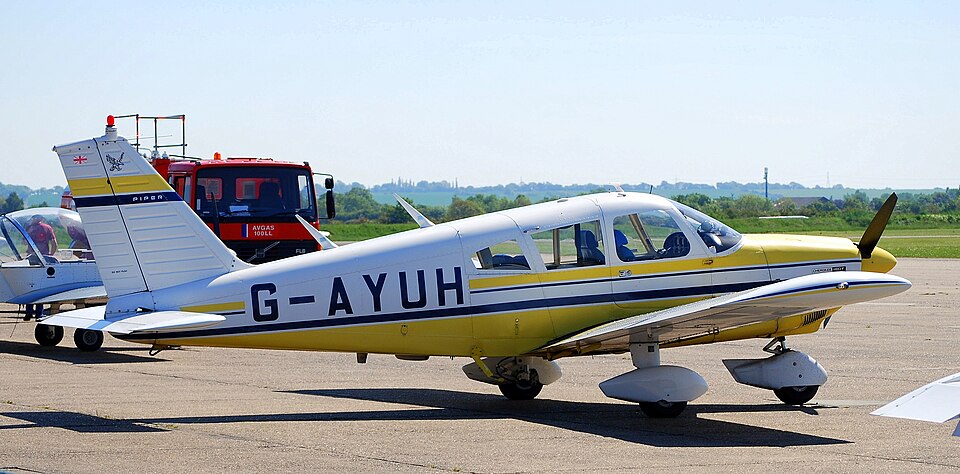
History of the Flight
The pilot, a 72-year-old with 407 hours of flying experience, departed Old Buckenham Airfield at 0753 UTC on 21 August 2023 in the Piper PA-28-180 (registration G-AYUH). The flight to Earls Colne Airfield was approximately 40 nm, with an estimated duration of 25 minutes. At 0805 UTC, while 8 nm north of the destination, the pilot called Earls Colne Radio, reporting abeam Sudbury at 1,500 ft and requesting airfield details. The radio operator provided runway, QNH/QFE, and wind information but did not report that the airfield was in fog. Earlier that morning, the airfield had been in fog, and the resident air ambulance had declared its helicopter off-line due to weather at 0630 UTC.
As G-AYUH approached Earls Colne, it descended near the edge of low cloud and fog visible on satellite imagery. At about 0815 UTC, the aircraft was at approximately 500 ft amsl (about 250 ft above airfield elevation). The pilot transmitted that he was entering thick cloud or fog and was returning to Old Buckenham. A witness, a private pilot, saw the aircraft approach from the north trying to stay below cloud at about 500 ft above ground. The witness lost sight of it as it passed between Colne Engaine and Halstead, then briefly saw it again heading north after an apparent turn.
Recorded data indicated the aircraft made a 270° left turn over Colne Engaine, then climbed to about 1,100 ft amsl (860 ft agl) and continued west. Another witness at Stanley Hall heard an aircraft approaching from the south-east but could not see it due to very low cloud; he heard the engine revving and then the sound passing overhead in a northerly direction. The aircraft descended to about 800 ft amsl (560 ft agl) near Stanley Hall and then resumed a climb. The same witness then saw the aircraft emerge from cloud about 100 m away in a 45° nose-down attitude with the right wing oriented toward the ground. It dropped out of sight behind a barn, followed by an explosion and black smoke. The first witness reported hearing full engine power and then a crash.
Accident Site
The aircraft came to rest inverted in a field adjacent to woodland, approximately 3 nm north of Earls Colne Airfield at an elevation of 240 ft amsl. A significant post-accident fire occurred. Examination of the wreckage indicated the aircraft first contacted tree tops about 200 m before the final resting place. The initial impact was by the right wingtip, then left wingtip and fin beacon light 75 m further. The aircraft was in a right-wing low attitude initially and inverted by the second contact. It continued inverted until coming to rest in a field, where the central fuselage was consumed by fire. The engine was producing power at impact; no pre-accident defects were found. The pilot sustained fatal injuries.
Recorded Information
The aircraft's avionics had no recording capability and were extensively damaged by fire. A fire-damaged tablet and mobile phone were recovered but yielded no data. Radar data from Stansted Airport and PilotAware Rosetta transmissions provided position, speed, and altitude information for the final minutes of the flight. The aircraft was last detected by radar at about 1,000 ft amsl; the next sweep did not detect it, possibly due to unusual attitude obscuring the transponder or rapid descent below radar coverage.