Accident Details
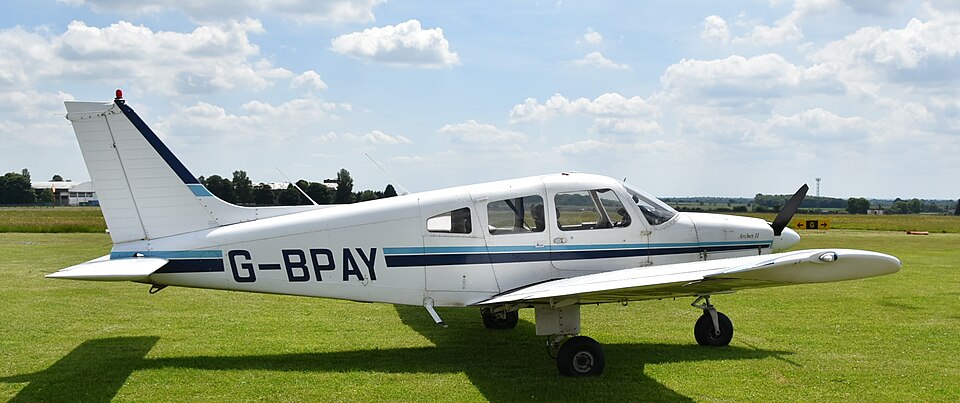
On 29 December 2016 at 1450 UTC, a Piper PA-28-181 Cherokee Archer II (registration G-BPAY, serial number 28-8090191) was involved in a ground collision at White Waltham Airfield, Berkshire. The aircraft, manufactured in 1980 and powered by a Lycoming O-360-A4M piston engine, was being flown by a 28-year-old pilot holding a Private Pilot’s License. The pilot was the sole person on board and reported no injuries. He had logged 68 total flight hours, including 63 on the accident aircraft type, with only one hour of flying in the preceding 90 days and one hour in the last 28 days.
Narrative
After completing a landing, the pilot taxied between two rows of parked aircraft. During this maneuver, the left wingtip fairing and leading edge of the left wing of G-BPAY struck the propeller spinner of an unoccupied Piper PA-28. The pilot stated that glare from the low sun may have contributed to his inaccurate assessment of the clearance between his aircraft and the parked one. He also observed that while the gap between the rows was sufficient for his aircraft to pass, the rows were positioned closer together than was customary at White Waltham Airfield.
The airfield operator later reported that the spacing between rows of aircraft was varied to prevent certain areas of the ground from becoming more worn than others, particularly when the ground was soft.
Aftermath
The accident resulted in damage to the wingtip fairing and leading edge of the left wing of the accident aircraft, as well as to the propeller spinner of the parked aircraft. No injuries occurred.
In response to the incident, the airfield operator implemented changes to its procedures aimed at reducing the need for parallel rows of parked aircraft, thereby decreasing the likelihood of ground collisions.
No official probable cause was determined.