Accident Overview
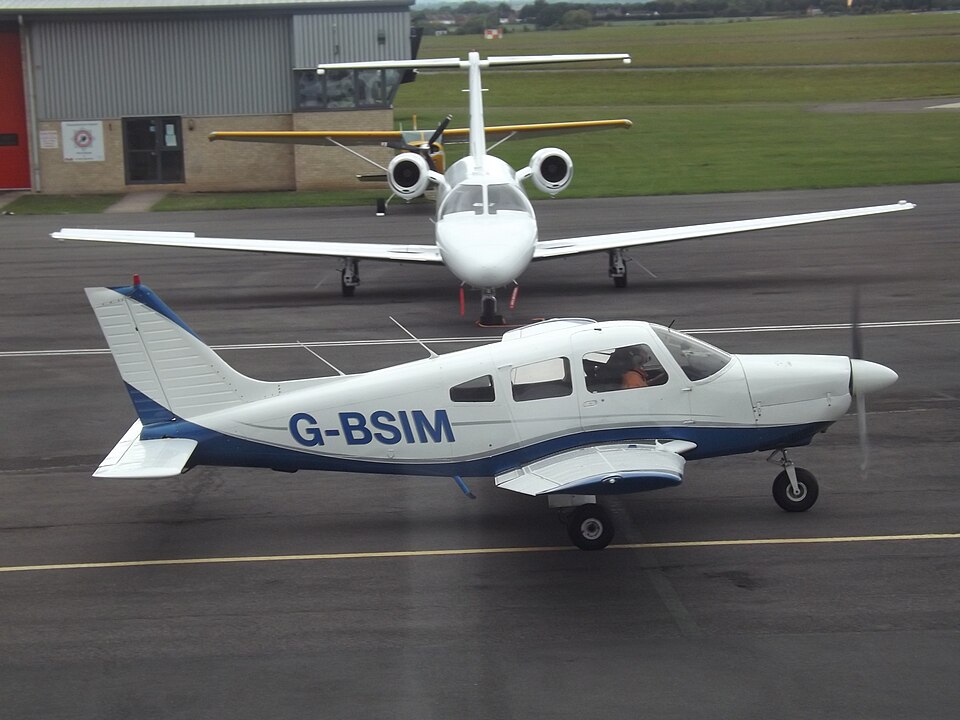
On 28 October 2014 at 1545 UTC, a Piper PA-28-181 Cherokee Archer II, registration G-BSIM, experienced a loss of engine power while operating in the visual circuit near RAF Henlow, Bedfordshire. The aircraft was on a private local general handling flight with only the pilot on board. The pilot, aged 50, held a Private Pilot's Licence and had 188 hours total flying experience, including 71 hours on type. In the 90 days prior to the accident, he had flown 4 hours, with 1 hour in the last 28 days.
Flight History
The flight departed from the grass Runway 20 at RAF Henlow at 1515 hrs. The weather was fine and clear, with a temperature of about 15°C. A weather front was approaching from the north-west, with associated cloud visible at a distance. Pre-flight preparations and engine checks were normal. The pilot completed three takeoffs and landings without incident, with engine performance appearing normal throughout.
On the fourth circuit, as the aircraft turned onto the base leg and the pilot applied carburettor heat prior to reducing power, there was an immediate drop in engine rpm accompanied by an increase in engine noise. The pilot throttled back, but the engine continued to run abnormally with erratic power delivery. It did not stop entirely. The pilot declared an emergency and performed cockpit actions in an attempt to restore engine power, but these were ineffective.
Forced Landing and Damage
With insufficient power to reach the runway, the pilot identified a field for a forced landing. Touchdown was made on the mainwheels, and the landing roll proceeded normally at first. However, the aircraft encountered a small land drain, which deformed the left main landing gear. This led to damage to the left wing and fuselage. The aircraft continued to decelerate for about 30 to 40 metres while yawing to the left, coming to rest having deviated 90° from the direction of landing. The pilot was uninjured.
Meteorological Conditions and Cause
The pilot reported that the loss of engine power was due to carburettor icing. The meteorological report from Luton Airport, 8.5 nautical miles to the south, at 1520 hrs recorded a temperature of 16°C and a dew point of 11°C. Over the next two hours, these values changed to 14°C and 13°C respectively. A graph predicting induction system icing risk indicated that under these conditions, the aircraft was at risk of moderate icing at cruise power and serious icing at descent power. A more refined version of the graph identified a risk of serious icing at both cruise and descent power settings for carburettor-equipped engines, such as the Lycoming O-360-A4M fitted to G-BSIM.