History of the Flight
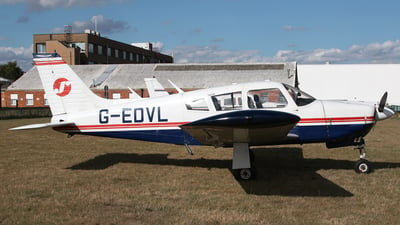
The aircraft, a Piper PA-28R-200-2 Cherokee Arrow II registration G-EDVL, was on a training flight to obtain a 'complex' aircraft rating for a student pilot. No defects were noted during pre-flight inspection. After start-up, ATC cleared the aircraft to taxi across grass and taxiways toward the holding point for Runway 26R. The student pilot taxied slowly over uneven grass onto Taxiway A. As the aircraft approached the holding point, the student turned onto a grass area for pre-takeoff power checks. A "thump" was heard, followed by the right wing dropping. The aircraft was stopped, and the instructor inspected it, finding the landing gear leg displaced from its normal position and a small hole in the upper wing surface. The aircraft was shut down and later recovered to a hangar.
Investigation
Examination revealed that the forward trunnion of the right main landing gear had failed, allowing the landing gear leg to rotate rearward, piercing the wing skin and causing the wing to drop. A small piece of material was missing from the trunnion and not recovered. Fracture analysis showed most surfaces had overload characteristics, but one area exhibited fatigue crack propagation, though the crack initiation site could not be identified due to mechanical damage.
The maintenance organisation had performed an annual inspection on 6 March 2018, including a visual check of the trunnions, with no evidence of cracking found. The trunnion location makes visual inspection impractical during pre-flight checks.
Redhill Aerodrome has grass runways and paved taxiways, with uneven grass areas typical for grass airfields. The flying club required taxiing at 'walking pace' on such ground. The aircraft logbook showed it had operated from other grass airfields, and no damage had been reported from hard landings or uneven surfaces.
Analysis
The accident was caused by the failure of the right main landing gear forward trunnion while taxiing. The fracture surfaces indicated overload failure with a region of fatigue crack progression. The crack likely grew under normal operating loads until the trunnion's strength was compromised, leading to overload failure. The fatigue crack initiation was probably the result of an unreported abnormal event, such as a heavy landing or rapid taxiing over uneven ground. No prior cracking had been detected during inspections.