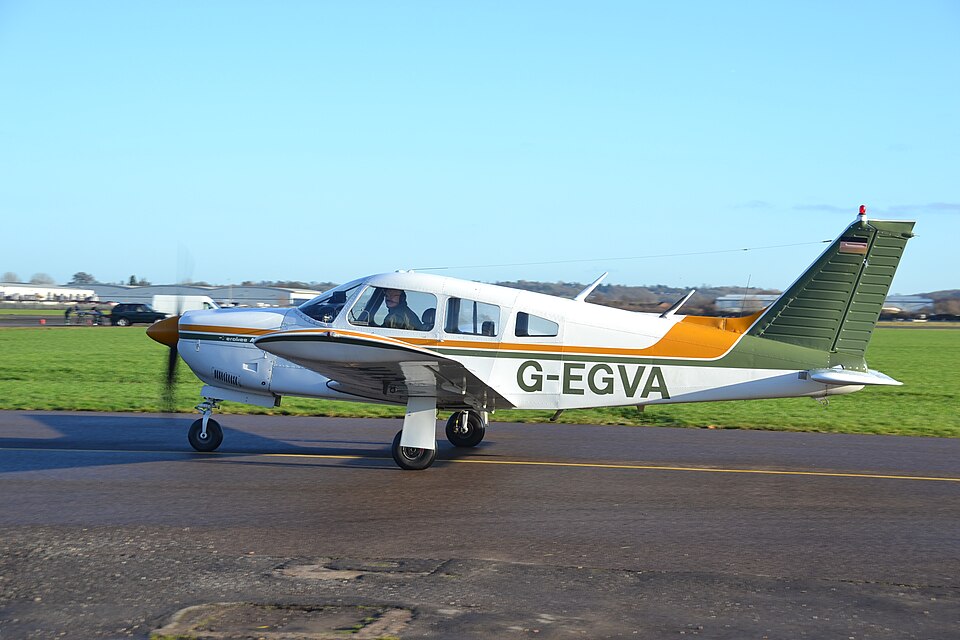
History of the flight
On 2 April 2022, a Piper PA-28R-200-2, registration G-EGVA, departed Wellesbourne Mountford Aerodrome as part of a club 'fly-out' to Le Touquet, France. The aircraft, operating under Visual Flight Rules (VFR), was one of seven aircraft participating. The pilot in the left seat held a Private Pilot's Licence and had 200 hours of flying experience, with 4.7 hours on type. The right-seat occupant was also a pilot. Neither pilot was qualified to fly in cloud.
At approximately 0916 UTC, as G-EGVA approached the middle of the English Channel, one occupant reported to London Information that they were in cloud. The aircraft then disappeared from radar. Radar data showed the aircraft descending rapidly, with its last known position at 50°34'23.49" N 001°04'11.23" E at 0916:31 UTC.
Meteorological conditions
A line of highly convective cloud was forecast on the intended route. Photographs taken by other aircraft at the time showed cumulus cloud with waterspouts descending from the cloud base. One aircraft flying under IFR estimated cloud tops at least 8,000 ft. Four of the five other VFR aircraft descended to find gaps around the cloud; one diverted to Shoreham.
Search and found items
The UK and French Aeronautical Rescue Coordination Centres launched an extensive search involving vessels and aircraft. Neither the aircraft nor its occupants were initially found. Subsequently, items washed ashore on the French coast: a bag containing the left-seat pilot's licence and logbook at Plage d'Equihen on 5 April, a kneeboard at Plage de Wimereux on 7 April, and a seat from G-EGVA at Plage de Sante-Cecile on 8 April. Both occupants are listed as missing.
Aircraft information
G-EGVA (serial no. 28R-76-35229, year of manufacture 1976) was a four-seat, single-engine aircraft with retractable landing gear, powered by a Lycoming IO-360-C1C engine. Its Airworthiness Review Certificate was valid until 21 March 2023. The most recent maintenance was an annual inspection carried out prior to the accident.
Probable cause
It is likely control of the aircraft was lost when the aircraft entered the convective cloud.