Introduction
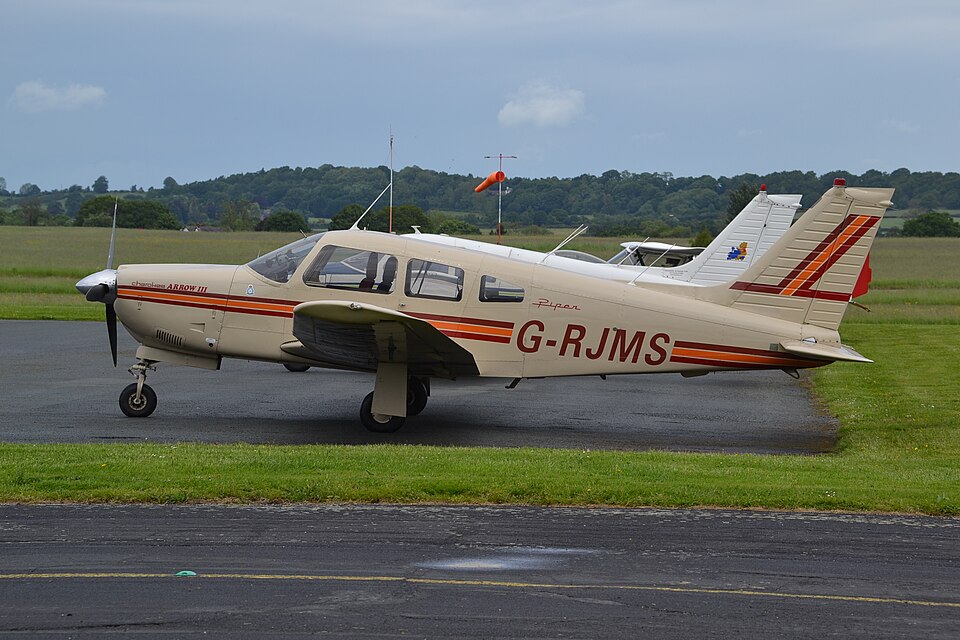
On 19 June 2015, a Piper PA-28R-201 Cherokee Arrow III, registration G-RJMS, was involved in an accident during takeoff at Crosland Moor Airfield, Yorkshire. The aircraft, manufactured in 1978, was on a private flight with one pilot and three passengers onboard.
History of the Flight
The pilot, aged 82, held a Private Pilot’s Licence and had 1,880 hours total flying experience, with 1,285 hours on type. The takeoff was from tarmac Runway 25 with a northwesterly wind at 12 kt. The pilot stated that he lined up on the left side of the runway to point as close to the wind direction as possible. As he opened the throttle and released the brakes, the aircraft developed a swing to the left, which he was unable to correct using right rudder. The left wingtip contacted bushes bordering the runway, increasing the yaw. The aircraft then left the runway, ran down an embankment, and struck a stone wall before coming to rest in a field with all three landing gear collapsed. The occupants evacuated normally. The two rear seat passengers, who were restrained by lap belts, sustained minor bruising.
Investigation
The AAIB received photographs showing faint propeller contact marks on the runway near the start of the takeoff roll. The pilot suggested that these marks might indicate the nose landing gear retracted, compromising his ability to steer. However, the marks were faint and did not persist for the entire ground roll. The AAIB noted that contact with the runway by a propeller under high power would typically leave deeper slash marks. No further examination was conducted to establish the condition of the nose landing gear.
Conclusion
The cause of the loss of directional control during takeoff has not been established.