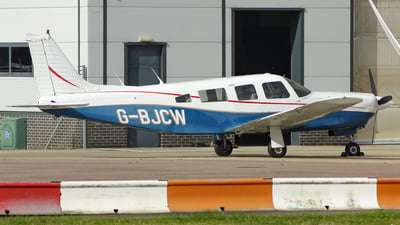
Incident Overview
On 4 August 2017 at 1404 UTC, a Piper PA-32R-301 Saratoga SP (registration G-BJCW) landed with its landing gear retracted at Bembridge Airport, Isle of Wight. The flight was conducted under a Private Pilot’s Licence with one pilot and one passenger on board. No injuries were reported among the occupants.
Aircraft and Pilot Details
The aircraft, manufactured in 1981, was powered by a single Lycoming IO-540-K1G5D piston engine. The pilot, aged 50, held a Private Pilot’s Licence and had accumulated 217 hours of total flying experience, of which only 5 hours were on the accident aircraft type. In the last 90 days, the pilot had flown 9 hours, with 2 hours in the last 28 days.
Accident Sequence
According to the pilot’s report submitted to the Aircraft Accident Report Form, the approach did not include a full circuit, which would have typically allowed him to conduct appropriate checks. The pilot stated that he did not hear an audible gear warning during the approach. He also noted that previously flown aircraft had a fixed undercarriage, which may have influenced his actions.
Audible Warning System
The aircraft is equipped with an audible warning system designed to alert the pilot if the landing gear is not extended and the throttle is retarded to a low power setting (below approximately 14 inches of manifold pressure). In this instance, it could not be determined whether the warning trigger conditions were not met, the warning activated but went unnoticed, or the system failed to function as intended. The serviceability of the audible warning system at the time of the accident remained unknown at the time of the bulletin’s publication.
Damage
The accident resulted in damage to the propeller, the underside skin of the aircraft, and bending of the flaps.
Investigation Source
This information is derived from the AAIB Bulletin 3/2018, based on the pilot’s own report.