History of the Flight
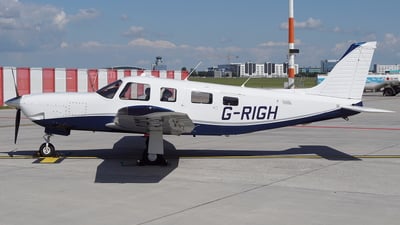
On 21 August 2014 at 1805 UTC, a Piper PA-32R-301 Saratoga SP (registration G-RIGH) was involved in an accident at Strathallan Airfield, Perthshire. The pilot, aged 75, held a Private Pilot’s Licence and had 2,305 hours of flying experience, of which 2,021 were on type. He had flown 35 hours in the last 90 days and 15 hours in the last 28 days. The aircraft, manufactured in 1998, was powered by a single Lycoming IO-540-K1G5 piston engine.
The pilot had arrived from Cumbernauld after refuelling the aircraft to full tanks. The reported temperature was approximately 23°C, pressure 1005 hPa, with a light crosswind. Recent heavy rain had left the grass strip wet. The pilot reported a normal approach, but the aircraft touched down “after considerable float”, having landed a few knots fast. The brakes proved ineffective on the wet grass, and the pilot was unable to prevent the aircraft from departing the end of the runway. It crashed through a fence and stopped approximately 15 m into the next field. The pilot was unhurt; he made the aircraft safe and vacated it normally.
Aerodrome Information
Strathallan has a grass strip 620 m long with two landing runways, 28 and 10. The field slopes down to the east with a gradient of approximately 0.5%, with trees and higher ground to the west of the threshold of Runway 10. The surface temperature and pressure at the time of the accident resulted in an airfield density altitude of approximately 1,300 ft.
Aircraft Performance
Information provided by the manufacturer indicates that the normal landing distance from 50 ft for this aircraft, when fitted with a three-bladed propeller, is 479 m including a ground roll of 309 m. The CAA Safety Sense Leaflet 7e ‘Airplane Performance’ highlights that the landing distance required on short wet grass may increase by 60%, before additional safety factors are added. Published performance figures assume that the aircraft touches down in the correct place at the correct speed.
Damage
The damage included a propeller blade, dents in the leading edge of both sides, and a scrape on the left engine side panel.
Probable Cause
The pilot concluded that the main cause of this accident was not touching down in the correct place. The slipperiness of the short wet grass, the lack of any headwind, the gentle downward slope and the density altitude were contributory factors.