History of the Flight
The flight departed Leeds Bradford Airport for Oxford Airport at night, carrying one pilot and one passenger. During the climb, the aircraft encountered intermittent instrument meteorological conditions. After reaching FL90, the pilot observed freezing rain and rapid ice accumulation on the windscreen and wings. He subsequently experienced difficulty controlling the aircraft, particularly in pitch. The pilot activated the de-icing system and requested a descent. Air traffic control (ATC) instructed him to maintain altitude due to other traffic. The pilot continued operating the de-icing system while attempting to maintain altitude. Approximately four minutes later, the ice cleared, and the aircraft continued to Oxford without further incident.
Air Traffic Control Report
Radar and radio recordings reviewed by the air traffic service provider revealed the following timeline: At 18:19:00, G-IFLP was level at FL90 while an Airbus A319 was inbound to Manchester Airport at FL80. G-IFLP was instructed to route to the Manchester VOR but turned west away from it. At 18:20:24, G-IFLP was at FL88, 5.5 nm from the Airbus. By 18:20:44, a fast and broken transmission from G-IFLP requested descent due to icing; the controller responded with "maintain FL90." The controller then contacted Manchester Approach to advise of G-IFLP's descent, and the approach controller turned the Airbus to re-establish lateral separation. At 18:21:08, separation was re-established. At 18:21:20, G-IFLP transmitted "losing control," which appeared to be missed by the controller, who instructed to "maintain at least FL80." An unknown pilot relayed that G-IFLP was losing control. The minimum recorded separation between the aircraft was 4.5 nm and 600 ft, below the required 5 nm or 1,000 ft.
Aircraft Information
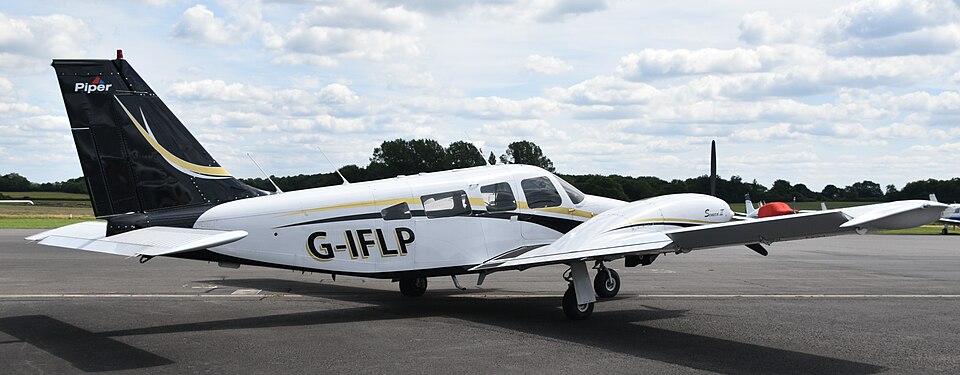
The Piper PA-34-200T Seneca II is an all-metal aircraft with retractable landing gear, two turbocharged piston engines, and seating for up to seven occupants. It is approved for IFR flight by day and night. G-IFLP was not fitted with an autopilot. The aircraft is approved for flight in icing conditions and is equipped with an ice protection system consisting of wing and empennage pneumatic boots, wing ice detection lights, electrothermal propeller deice pads, and an electrically heated windshield panel. The pneumatic boots are inflated for six seconds via an engine-driven pressure pump. The Pilot's Operating Handbook recommends cycling the boots when ice has built to between 1/4 and 1/2 inch thickness. The system may not shed light ice or heavy ice that exceeds boot capability. The limitations section warns against severe icing and notes that flight in freezing rain, freezing drizzle, or mixed icing may exceed the ice protection system's capabilities.
Meteorological Conditions
The Met Office forecast for the time of the incident indicated moderate icing from between 4,000 ft and 5,000 ft up to 10,000 ft, with severe icing forecast within isolated cumulonimbus cloud embedded in an occluded front.
Analysis
G-IFLP descended below its cleared level due to control difficulties associated with ice accumulation on the airframe. Moderate icing was forecast on the planned route, with severe icing within embedded cumulonimbus. This descent resulted in a loss of separation with another aircraft. The pilot's focus on flying the aircraft and operating the de-icing system limited his capacity to communicate the urgency of the situation to ATC. The controller did not detect the urgency in the pilot's initial request for descent. Another pilot on the frequency assisted by relaying the urgency. With hindsight, the pilot considered that a PAN or MAYDAY call could have ensured the controller understood the severity; however, at the time, his primary focus was on aircraft control.