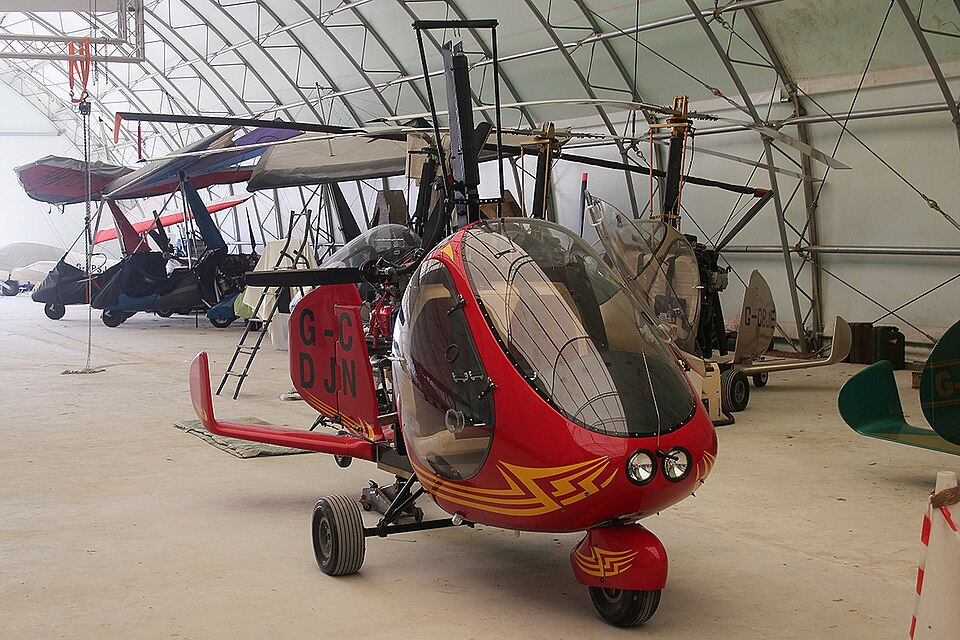
History of the Flight
On 15 September 2023 at 1405 UTC, the pilot of a RAF 2000 GTX-SE gyrocopter (registration G-CDJN) prepared for takeoff from Great Heck Airstrip in North Yorkshire. After starting the engine and completing checklists from memory, he began pre-rotating the rotor. Realizing he had forgotten his pen and sun cap, he shut down the engine, applied the rotor brake, and exited the aircraft to retrieve them. Upon returning, he restarted the engine and noted that pre-rotation took "an unusually long time" but did not investigate further. After takeoff, the gyrocopter initially climbed before starting to descend as it flew toward a canal perpendicular to the runway end.
The pilot, startled by the descent, maneuvered away from a line of trees ahead and a railway line to his left, turning right to fly into wind along the canal. Unable to land on the narrow canal banks without striking foliage, he decided to ditch in the canal. During the ditching, the main rotor struck the canal bank and detached. The aircraft sank, but the pilot escaped through the passenger door as the pilot's door was wedged against the bank.
Pilot's Comments
Shortly after the accident, the pilot spoke with a friend in a nearby field who reported hearing a sound like the engine speed reducing. The pilot attributed this to the Doppler effect, as he believed the engine was working normally, though he had not checked his instruments. With hindsight, the pilot concluded that he had left the rotor brake applied when he re-entered the aircraft after retrieving his items. He stated that had he restarted his checklist from the beginning, he would have remembered to disengage the rotor brake before pre-rotation. G-CDJN was not fitted with a rotor brake warning light, which is not part of the standard RAF-2000 build kit. The pilot noted that the rotor brake, while ineffective when cold, becomes more effective as it warms up due to friction.
The pilot provided checklists from another aircraft of the same type, dated 2001 and 2004. Neither included an item to check that the rotor brake is disengaged before engaging the main rotor clutch before takeoff. However, in his own copy, the pilot had added "rotor brake off, swing rotor" at the start of the before-starting-engine checks. He owns another gyrocopter with a rotor brake warning light and had planned to install one on G-CDJN but had not done so.
AAIB Comment
The AAIB noted that performing checklists without interruption is important. In this case, the interruption caused by exiting the aircraft likely resulted in the rotor brake being left applied. As the brake warmed from friction, it became more effective, leading to the loss of performance and forced landing. The pilot had limited options due to the railway line and tree line, and it was fortunate he escaped uninjured after the aircraft sank. The original manufacturer's checklist did not include a step to verify the rotor brake was off before pre-rotation, but the pilot's amended copy did. The AAIB did not issue a Safety Recommendation as the manufacturer is no longer in business, but shared the finding with the current organization responsible for the RAF-2000 design. The AAIB also emphasized the value of identifying available options before flight to improve forced landing outcomes, especially near obstacles like water, railways, or trees.