Introduction
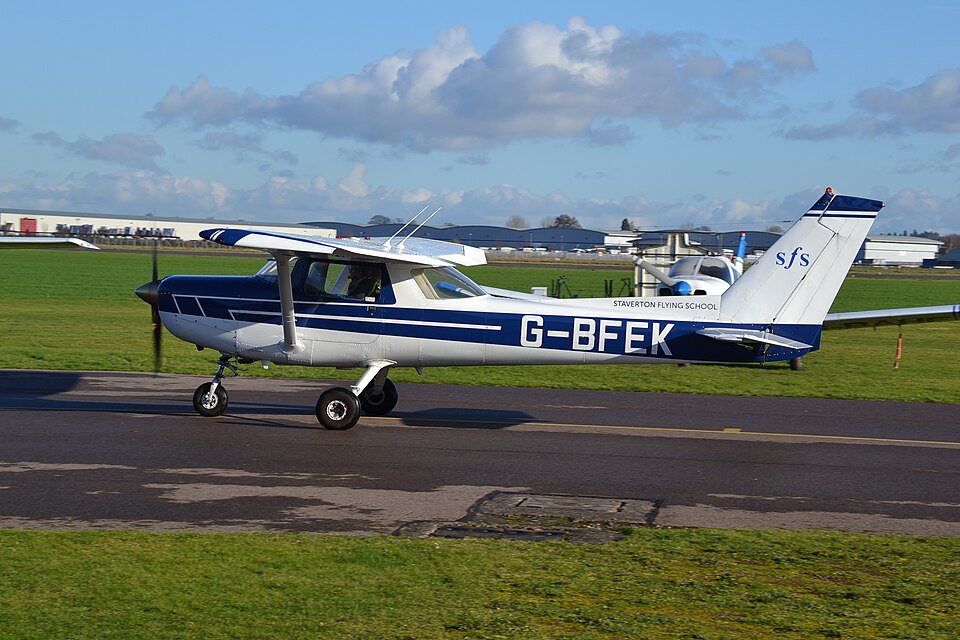
On 2 February 2016, a Reims Cessna F152 (registration G-BFEK) sustained damage to its right wing tip, propeller, and engine after tipping onto its right side while holding at Gloucestershire Airport. The aircraft was conducting a solo training flight with a student pilot on board, who was not injured.
Circumstances
The student pilot, aged 53 with 27 hours of flying experience (26 on type), had just completed three dual circuits with an instructor. The wind was reported as 270°/13 kt at the time of the last landing, and the instructor considered conditions suitable for solo flight. The pilot taxied to holding point A2 for Runway 27 and positioned the aircraft to maintain visibility of final approach traffic. After waiting approximately two minutes, the aircraft suddenly tipped to the right without warning, pivoting on its nose and right main wheel before coming to rest on the right wing tip, right main wheel, and propeller. The pilot then made a PAN call and shut down the aircraft before exiting through the passenger door.
Investigation
The airfield operator's investigation included reviewing ATC recordings and gathering information from the flying school and helicopter operator. At the time of the incident, a Eurocopter EC145 helicopter had completed a rotors-running refuel and was hover taxiing behind the Cessna, having received ATC clearance. Another helicopter, a Robinson R44, was on the ground at the Avgas pumps with rotors running. The EC145 pilot was aware of both aircraft and selected a path that maximized clearance, estimated to pass between two and three rotor diameters from the Cessna. The EC145 has a main rotor diameter of 11 m. The R44 instructor later noted she was relieved her rotors were at operating rpm as the downwash from the EC145 might have caused problems. The airfield operator's report indicated that the Cessna's position was typical of many aircraft stopping short of the holding point.
Weather
The pilot reported the wind as 280°/13 kt when ready for takeoff. The METAR at the accident time (1320 UTC) recorded wind 290°/15 kt, gusting 25 kt, with a strong wind warning in effect. Over the period 1020 to 1420 UTC, the wind veered from 240° to 300°.
Safety Actions
The incident occurred in a congested part of the airfield already identified as a 'Hot Spot'. The airfield operator implemented changes including discontinuing rotors-running refueling on the large 'H' and restricting use of helicopter landing spots when fixed-wing aircraft are holding at A2. Fixed-wing operators are encouraged to 'move up' at holding points to increase separation from rotary traffic.
Discussion
The Cessna 152 was tipped over, most probably as a result of the main rotor downwash generated by the EC145 helicopter hover taxiing behind it at a distance of between two and three rotor diameters. The effects of the downwash may have been exacerbated by the wind speed and direction. The METAR indicated increased wind strength and a veer in direction during the period. The EC145 pilot maximized separation from both the Cessna and the R44, but the Cessna was holding well short of the stop line, which reduced separation. The event highlights the challenges of mixing rotary and fixed-wing operations in confined areas.