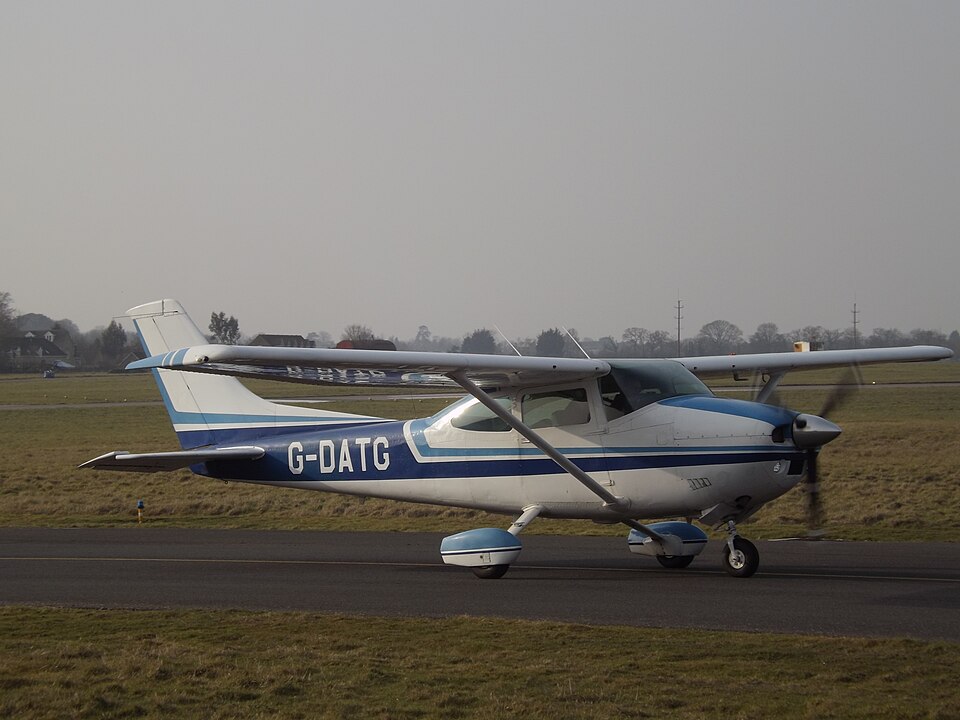
Accident Overview
On 10 July 2016 at 1520 UTC, a Reims Cessna F182P Skylane (registration G-DATG) overran the end of a private grass airstrip near Westcott, Buckinghamshire, during landing. The aircraft sustained substantial damage to the engine, propeller, fuselage, wings, and landing gear. The pilot and one of the two passengers sustained minor injuries.
Flight History
The flight departed Oxford Kidlington Airport at 1400 hrs with a pilot and two passengers. The intended destination was a private grass airstrip approximately 13 nm east of Kidlington, which the pilot had visited three times previously. Weather was generally fine with good visibility, scattered to broken cloud between 3,000 ft and 4,000 ft. An automated weather station at the airstrip reported wind from about 240° at 16 kt before departure. The airstrip was orientated 15/33, subjecting the approach to a crosswind.
On arrival overhead, the windsock indicated direct crosswind at an estimated 10 to 15 kt. The pilot commenced an approach to land on runway 33. He experienced blustery crosswind conditions and selected flaps at 20° instead of 40°, believing it recommended for the conditions. The approach was not fully stabilised, with airspeed varying by +/-10 kt.
Touchdown occurred an estimated 30 m into the 540 m strip. Wheel braking initially felt effective, but overall deceleration was less than expected despite maximum braking without locking the wheels. The aircraft continued past the strip end, passing through a hedge and a small ditch onto a minor road, where it came to rest facing east. The cockpit and cabin area sustained minimal damage. All occupants wore shoulder and lap straps.
Pilot Actions and Assessment
The pilot later considered his decision to use flap 20° a mistake. He noted the wind conditions prevented fully stabilising speed and that he should have initiated a go-around earlier. He attributed the reduced brake effectiveness possibly to higher touchdown speed and damp grass. He elected not to reject the landing after touchdown, deeming low-speed overrun less risky. He intended to raise flaps to improve braking, but the aircraft came to rest with flaps still at 20°.
Meteorological Information
A low-pressure area west of Ireland placed England and Wales in a south-westerly airflow of about 15 kt, with a weak occluded front forecast to cross the area. Weather reports from Oxford Kidlington (13 nm west) showed steady wind from 230° to 240°. Luton Airport (22 nm east) reported surface wind from 210°, varying between 150° and 240°. The wind direction veered later in the afternoon, suggesting the front crossed the area.
Aircraft Information
The Cessna F182P Pilot’s Operating Handbook (POH) permits flap settings from 0° to 40° for normal landings. Power-on approach speeds are 70-80 kt (flaps 0°) and 60-70 kt (flaps down). Landing performance figures are based on short-field technique: flaps 40°, power off, speed 60 kt, heavy braking after touchdown. The POH advises retracting flaps to 0° to improve braking effectiveness and, for crosswinds, using the minimum flap setting required for field length.
Performance Calculation
The airstrip was 540 m long, average elevation 270 ft, with a downslope of about 1% in the 33 direction. Temperature was 22°C, QNH 1006 hPa. The pilot used a computer programme from the aircraft group’s internet site for performance calculations. The programme input landing mass of 2,732 lb (1,239 kg), about 92% of maximum allowable. All performance figures were based on maximum landing mass, flap 40°, power off, 60 kt approach speed, and heavy braking.
The programme calculated a landing ground roll of 645 ft (197 m) and an uncorrected landing distance from 50 ft of 1,440 ft (439 m). A 15% increment for grass surface gave 1,656 ft (505 m). However, the POH recommends 20% for grass, and the programme did not account for runway slope. The ground roll figure was titled ambiguously and did not reflect grass surface conditions. The programme also applied a 1.43 safety factor automatically, giving a landing distance from 50 ft of 2,368 ft (722 m).
If a 20% grass factor and 5% slope factor were applied, the landing ground roll would be 1,019 ft (310 m) and landing distance from 50 ft would be 1,814 ft (553 m), exceeding the 540 m available. The programme’s shortcomings included using a less than recommended grass factor, no slope input, and an erroneous ground roll figure.
Analysis
The performance programme’s deficiencies may not have been apparent on longer paved runways but could be significant on short strips. The pilot may have been misled by the erroneous ground roll figure and considered the landing mass sufficiently below maximum to provide margin. His previous successful visits to the airstrip may have influenced his decision. An additional factor not considered in calculations was a possible tailwind component due to wind variability.