History of the Flight
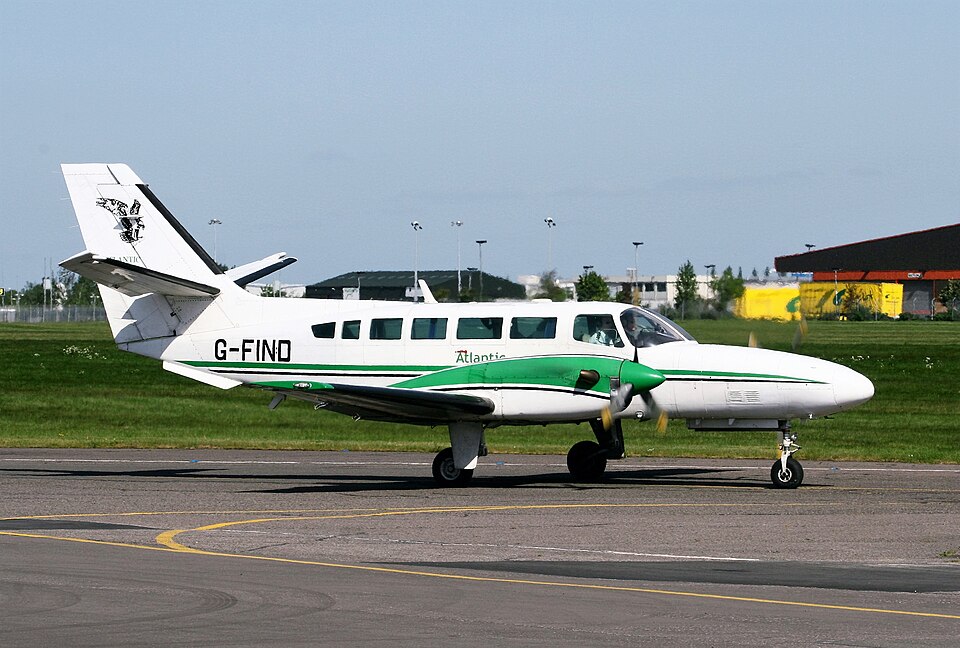
On 25 September 2016, a Reims Cessna F406 Caravan II, registration G-FIND, was operating a series of four training flights for proficiency checks on two company pilots. The aircraft commander, serving as the examiner, along with the two pilots undergoing checks, occupied the seats. During control checks before takeoff on the second flight, the crew noticed the pitch trim wheel moving and the trim running forward (nose-down sense) in three separate bursts, possibly due to inadvertent operation of the electric trim switch. They repeated the checks three times with no further anomalies, and the second and third flights were completed without incident.
For the fourth flight, departing from Coventry Airport, the plan included a visual circuit with one engine simulated inoperative, followed by restoration of normal power and transit to East Midlands Airport. The pilot under check sat in the right-hand seat. After the circuit, the aircraft climbed to 3,000 ft. The autopilot was engaged at 1,500 ft but disconnected at 2,500 ft with audio and visual warnings. The climb was completed manually, and the autopilot was re-engaged in heading and altitude hold modes during stable cruise.
As the aircraft neared East Midlands, it suddenly pitched nose-down. The handling pilot immediately attempted to correct by pulling back on the control wheel and pressing the autopilot disconnect button on it. No aural warning indicated autopilot disengagement, and increasing back pressure was needed. The pilot then used the disconnect button on the left control wheel and set the autopilot master switch to off; again no disconnect aural warning was heard. The aircraft reached a 10° nose-down attitude with increasing airspeed. The commander saw an abnormally forward pitch trim indication and manually reset the trim to the takeoff setting, requiring one and a half to two revolutions of the pitch trim wheel. The handling pilot then flew normally with manual trim. Neither pilot had observed the pitch trim moving before or during the event. The flight continued manually without further incident.
Previous Occurrences
G-FIND experienced a similar incident on 6 September 2007 (AAIB Bulletin 6/2008) during a crew training flight, where control restrictions occurred. The technical investigation was inconclusive but suggested an accidental and undiagnosed autopilot engagement during intended manual flight.
Another aircraft, G-TWIG, was involved in a fatal accident on 22 October 2004 (AAIB Bulletin 7/2006). It deviated from controlled flight and struck the ground in a steep dive at high speed. Extensive wreckage fragmentation ruled out major failures, but insufficient evidence prevented firm conclusions. Investigation of pitch trim system components found the trim setting almost fully nose-down at impact. Electric trim malfunction could not be dismissed, but flight tests indicated that control forces for such a nose-down trim could be overcome with little difficulty. Autopilot malfunction was also considered, specifically a spurious nose-down input followed by failure of a safety system intended to disengage the autopilot at 21° nose-down pitch; control forces to counter the failure might have been significant, but switching off the autopilot and manual re-trimming was expected.
Operator Actions
The operator removed the Air Data Computer and Autoflight Computer from G-FIND and fitted replacement units. The original units were sent to the manufacturer for strip down and fault diagnosis; results were pending at the time of reporting.
Following the 2007 incident, the operator contracted an approved design organisation to develop an autopilot system modification. This modification added a prominent autopilot disconnect switch and warning light, enabling pilots to isolate autopilot servos and trim actuator for quick manual flight. The modification was successfully used during the 25 September 2016 incident. Consequently, three newly acquired F406 aircraft were being retrofitted with the modification.