History of the Flight
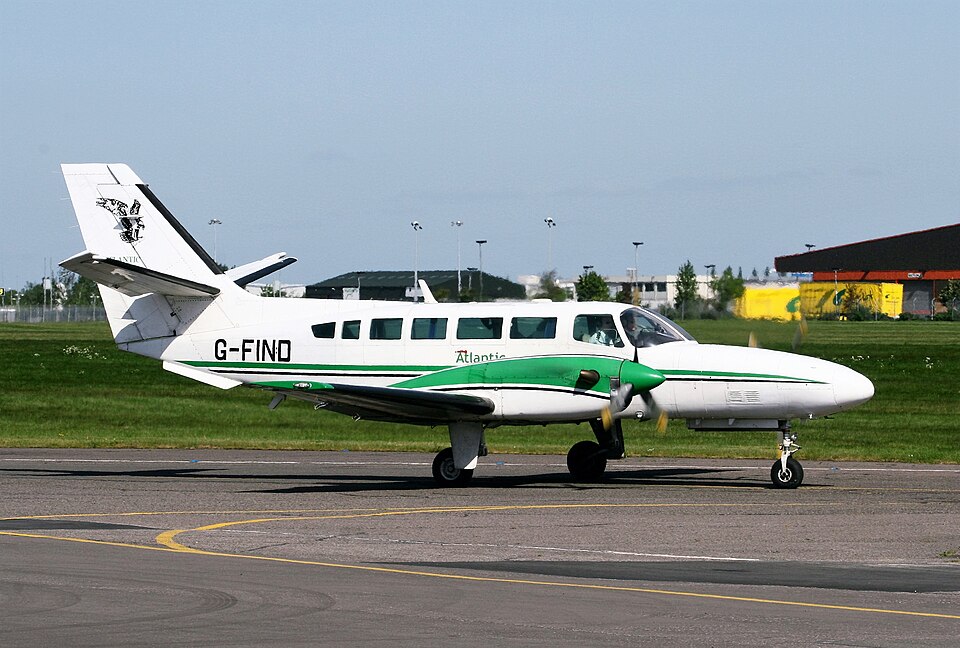
The flight was a specialised aerial photography operation over Northamptonshire, operated by a single pilot and a task specialist. The aircraft, a Reims Cessna F406 (registration G-FIND) powered by two Pratt & Whitney Canada PT6A-112 turboprop engines, was equipped with a cabin-mounted camera system that photographed through holes in the fuselage bottom. After departing East Midlands Airport at 0815 hrs, the aircraft flew a series of parallel lines at 12,000 ft. At about 1125 hrs, the task specialist reported feeling unwell and lost consciousness within seconds. The pilot declared an emergency, initiated a rapid descent, and diverted to London Luton Airport. As the aircraft descended through approximately 6,000 ft, the task specialist regained consciousness and was able to communicate. At 3,000 ft, he returned to his seat and spoke normally. The aircraft landed at Luton at 1145 hrs, and the task specialist was taken to hospital as a precaution.
Personnel Information
The task specialist, aged 25, described himself as fit and healthy, had passed a medical within the previous 12 months, and had no history of medical conditions. He had previously flown unpressurised flights up to 10,000 ft and had used supplementary oxygen above 13,000 ft, but this was his first flight at 12,000 ft without supplemental oxygen. He recalled feeling well before the flight, was not stressed or anxious, and was well hydrated. After about three hours, he felt dizzy and sweaty, then lost consciousness. He did not recall hyperventilating. Hospital tests after the incident did not identify a cause for the loss of consciousness.
Operational Procedures
The operator’s operations were governed by Part-CAT and Part-SPO regulations. The operator applied Part-CAT requirements to all operations, but those rules did not specifically address task specialists. Part-SPO required task specialists to use supplemental oxygen above 10,000 ft for more than 30 minutes, but this was not included in the operator’s manual accepted by the CAA. The operator’s manual considered task specialists as 'additional crew' and did not require oxygen below 13,000 ft. Following the incident, the operator updated the manual to require task specialists and survey operators to use supplementary oxygen at all times above 10,000 ft.
Analysis
The cause of the task specialist’s loss of consciousness could not be determined. Hypoxia was considered as a possible explanation, but it was deemed unlikely that a fit and healthy individual would experience transient loss of consciousness due to hypoxia at 12,000 ft unless combined with significant hyperventilation. The possibility of a higher natural tendency to faint combining with mild hypoxia was noted. No medical condition was found to explain the event.
Safety Action
The operator revised its Operations Manual to mandate supplementary oxygen use for task specialists and survey operators during all unpressurised flights above 10,000 ft.