History of Flight
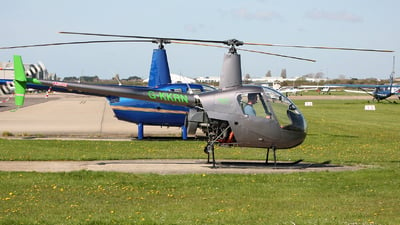
On 3 February 2025, a Robinson R22 Beta (G-KKRN) was conducting a training flight near White Waltham, Berkshire. The trainee pilot, qualified on the Guimbal Cabri G2, was undergoing a type conversion course. The second flight of the day included simulated emergency handling and autorotation practice. While positioning to rejoin the circuit at White Waltham, the instructor asked the trainee to descend. The trainee initially did not select carburettor heating; the instructor reminded him and then instructed him to continue the descent. The trainee reached down and pulled what he thought was the carb heat control but was actually the mixture control, moving it to the lean position and causing the engine to stop. The instructor immediately took control and entered autorotation from approximately 800 ft agl. With insufficient height for an engine restart, he focused on an engine-off landing in a ploughed field. The helicopter touched down at less than 5 kt, the skids dug into the soil, and the helicopter tipped forward and rolled onto its right side. The main rotors struck the empennage, which detached. Both pilots evacuated through the left door; neither was injured.
Aircraft Information
G-KKRN was a 1989 Robinson R22 Beta powered by a Lycoming O-320-B2C engine. The carburettor heating control is located on the centre console aft and right of the cyclic stick boot. The mixture control is directly forward of the carb heat control, close to the lower instrument panel. It is coloured red, has a different shape, and includes a friction release button. A plastic tubular guard is normally placed around the mixture control stem to prevent inadvertent operation. The guard can be dislodged if a pilot slides fingers under the control and applies upward pressure.
Analysis and Observations
The accident resulted from the misidentification of a critical control by a qualified pilot inexperienced on type. The risk of misidentification was first formally documented by the manufacturer in January 1981 in Safety Notice SN-1. The instructor was aware of the risk and briefed the student before the flight. Despite the mixture guard, the student's instinctive action without visually identifying the control overcame the safety barrier and caused an unintended engine shutdown. The instructor appropriately prioritised establishing autorotation over attempting a restart. This accident is a reminder that while risks can be identified and mitigated, human performance limitations mean lapses cannot be completely eradicated.