Background
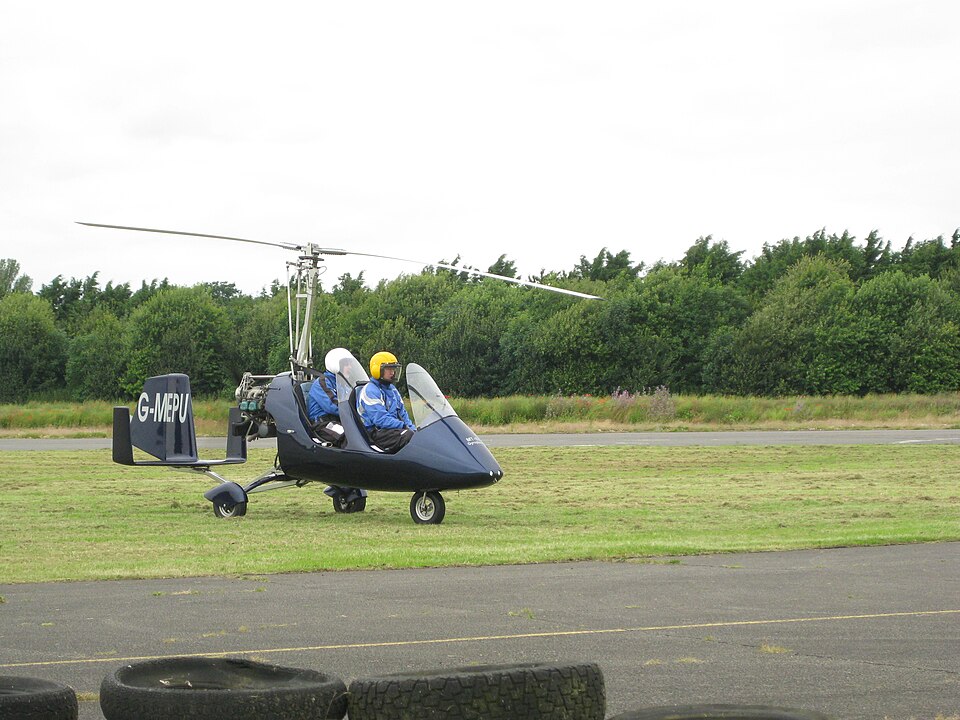
The accident involved a Rotorsport UK MT-03 gyroplane, registration G-MEPU, with a single Rotax 912 ULS piston engine. The aircraft was manufactured in 2006 and was on a solo training flight. The pilot, aged 79, held a fixed-wing Private Pilot's Licence and was nearing the end of a gyroplane training course, with 41 hours on type and a total of 1,650 flying hours. He intended to practice low approaches and go-arounds in preparation for his General Flight Test.
History of the Flight
The pilot arrived at Turweston Aerodrome on 28 July 2016 and conducted daily checks with his instructor. The weather was fine with a surface wind from 220° at 12 kt and temperature 18°C. The pilot flew a first local flight from 0910 to 0950 hrs, consisting of general handling and one approach and landing. After landing, he discussed refining his landing technique with his instructor and planned to fly low approaches and go-arounds on the second flight.
At 1003 hrs, the pilot took off again, flew north briefly, then joined the circuit for Runway 27. He performed a normal powered approach and initiated a go-around just above the runway, transmitting "going around". The gyroplane accelerated at low height, reached climbing speed, and began climbing away. The instructor observed this and described it as normal.
Accident
At an estimated height of about 100 ft, the gyroplane suddenly rolled quickly to one side and dove to the ground, striking the asphalt runway approximately 580 m from the Runway 27 threshold. No emergency radio call was made, and nothing detached from the aircraft in flight. The pilot did not survive.
Eyewitnesses consistently reported that the gyroplane was in normal flight before suddenly and quickly rolling to one side, then descending steeply nose-down. One witness described a noticeable pitching or 'porpoising' motion during the early go-around. The instructor, viewing from a different angle, did not recall significant pitch variations.
Post-Accident Response
Aerodrome personnel sounded the crash alarm and dispatched a response vehicle to the accident site about 400 m away. The pilot had not survived. There was no fire, but fuel leakage was managed with foam. Civil emergency services attended. The pilot's flying helmet had detached due to failure of its restraining strap, occurring late in the accident sequence.
Aircraft Examination
Examination revealed the aircraft struck the runway in a steep descent with considerable rotational energy in the main rotor blades, which separated upon impact. The fuselage forward of the front occupant position was destroyed, instruments fragmented. The control system was jammed by distortion but showed no pre-impact failure. The engine had no evidence of failure; carburettor float chambers were nearly full of fuel. Propeller damage was limited and occurred late in the impact sequence, not indicative of engine power at impact.
Medical Findings
The pilot's family and colleagues considered him fit and active, with no known medical conditions. He held a valid Class Two medical certificate issued in February 2016 after an electrocardiogram. A post-mortem examination revealed severe and extensive coronary artery atherosclerosis, of a severity that could have caused sudden death in the absence of an accident. The pathologist reported it was 'very likely that a sudden cardiac event, possibly causing unconsciousness, precipitated the accident'.