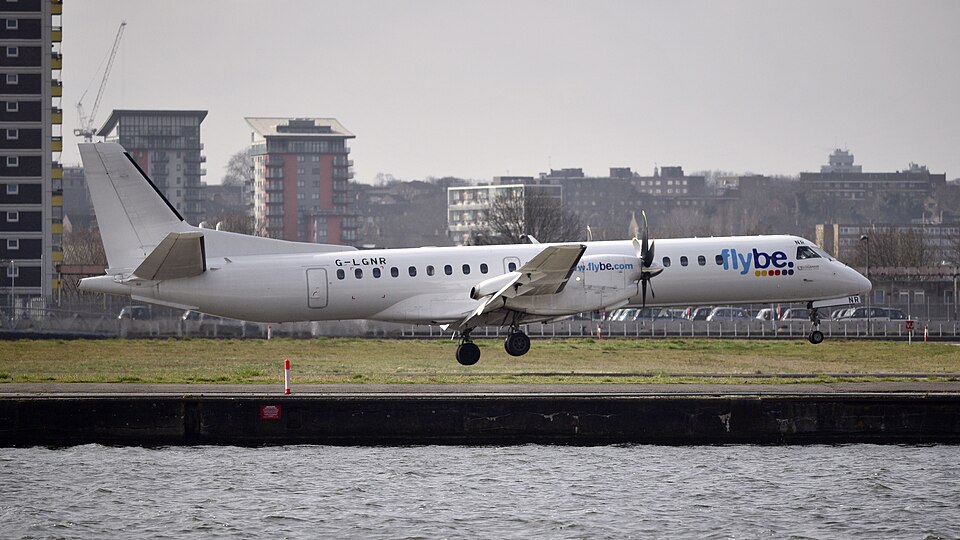
History of the Flight
The aircraft, a Saab 2000 registered G-LGNR, was operating a commercial air transport flight from Manchester to Inverness. It departed at 1630 hrs on 6 November 2015. The initial part of the flight was uneventful, with the autopilot engaged during the climb. After levelling at FL090 and accelerating to 240 kt in VMC, the primary flight display indicated a nose-up attitude of 7° and 10° of left roll, an unusual attitude for straight and level flight. The pilot felt the aircraft was not in balance. A yellow 'r' mistrim indication illuminated on the PFD, indicating untrimmed forces in the aileron system.
The pilot flying (PF) disconnected the autopilot, bracing for a jolt due to the aileron mistrim; the jolt was more pronounced than usual. The PF had difficulty maintaining straight and level flight, describing the aileron controls as “sloppy” and unresponsive. Airspeed was reduced to below 200 KIAS. The pilot monitoring (PM) viewed the Flight Control System (FCS) synoptic page on the Secondary EICAS Display (SED), which showed both ailerons deflected upwards: left aileron up 8°, right aileron up 5°. While viewing, both depictions briefly deflected to 17°.
The pilots concluded there was an aileron problem and consulted the malfunction checklist. They reviewed ‘Aileron system jammed’ and ‘Aileron system open failure’ checklists, but neither fit the symptoms. They decided to action the ‘Aileron system open failure’ checklist, which involved pulling the roll handle to separate the left and right aileron control systems. After pulling the handle, both pilots flew the aircraft to assess control; the left control wheel was more effective, so the commander remained PF. A PAN call was upgraded to MAYDAY once it was clear that a landing would be necessary with compromised flight controls.
The pilots returned to Manchester, informing ATC of reduced turning capability. The cabin crew were briefed. An ILS approach to Runway 23R was planned. Passing 4,000 ft, the PF requested Flap 15 extension to test controllability; at 7° flaps the aircraft became more difficult to control, and at 13° flaps were reselected up. A Flap 0 landing was planned with Vref 152 kt. On approach at about 200 ft agl, TAWS ‘too low terrain’ and ‘glideslope’ cautions sounded, but the PF could see the runway clearly, and the aircraft landed safely.
Recorded Information
Quick Access Recorder (QAR) data from the incident flight showed that at 1,200 ft radio height, as the aircraft accelerated through 150 kt, the recorded rudder trim position rapidly changed from approximately neutral to 22° right; the rudder surface position remained unchanged at 2° right, but both ailerons indicated a deflection of about 1.5° in a ‘roll left’ sense to maintain wings-level attitude. The autopilot engaged at 1,600 ft, simultaneously the yaw damper disengaged (though the manufacturer advised the yaw damper engagement status discrete parameter may not accurately reflect actual engagement). Twenty-two seconds later, recorded rudder trim changed to 4° right. No warnings of autopilot roll mistrim, yaw autotrim, or rudder control were recorded.
For the next four minutes, ailerons showed ‘roll left’ deflections of about 2°, and rudder trim varied between 6° right and 22° right. Lateral acceleration of 0.05g and a slight negative roll attitude indicated the aircraft was flying out of balance. At FL090, acceleration to 245 kt increased aileron deflection to 3° and lateral acceleration to 0.1g; an aileron mistrim annunciation recorded for ten seconds. At the end of this warning, the autopilot disengaged (manually or automatically). Roll attitude changed from -5° to wings level in about a second, but aileron deflections and lateral acceleration imbalances remained; rudder trim indicated 12° right, slowly trending neutral. Half a minute later, a ‘jolt’ in lateral acceleration was recorded, and over 15 seconds both ailerons returned to neutral, lateral acceleration zeroed, and rudder trim settled at 4° left. Rudder position changed from 2° right to about 4.5° left. Airspeed was reduced to between 190 and 200 kt.
Systems Description
The Saab 2000 has conventional mechanical roll controls and fly-by-wire with hydraulic servos in pitch and yaw. The aileron control system uses cables and pulleys with a range of +20° down to -24.2° up. The roll handle separates left and right aileron control systems. Aileron trim tabs are electrically operated. The autopilot roll channel moves ailerons via an electric servomotor; high loads trigger a yellow 'r' mistrim on PFD and, if persistent, an 'ap roll auto mistrim' caution. The rudder control system is dual, with pedals, LVDTs, RCUs, and hydraulic servo actuators, including yaw damper and trim. Rudder trim is adjusted manually or via autotrim commanded by the FCC to eliminate steady lateral accelerations.