Incident Overview
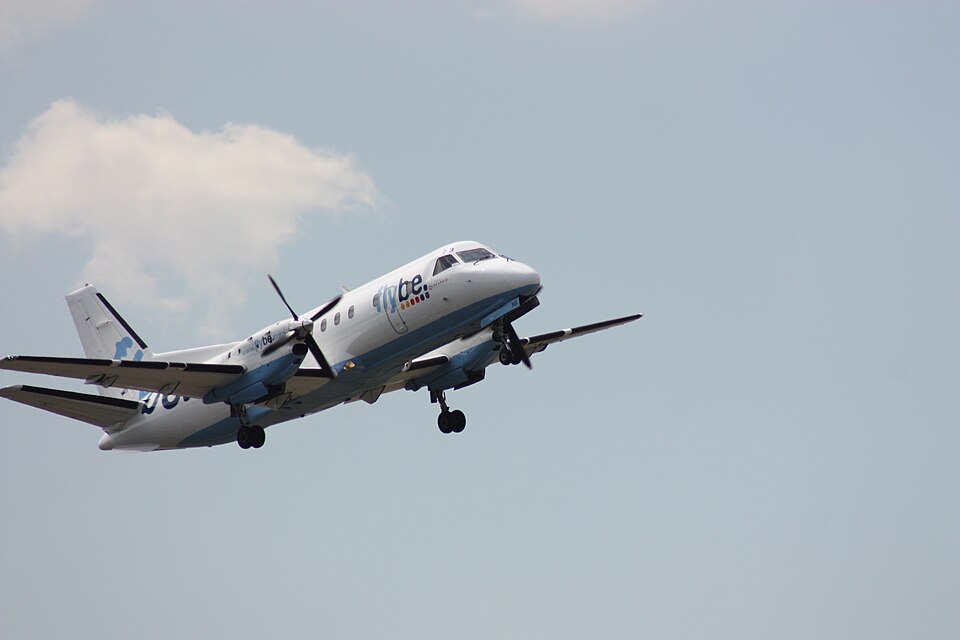
On 5 June 2017, a Saab-Scania SF340B (registration G-LGNB) operating a scheduled commercial passenger flight from Edinburgh Airport to Sumburgh Airport experienced severe icing and turbulence during climb. The aircraft, manufactured in 1990, was powered by two General Electric CT7-9B turboprop engines. There were 3 crew and 33 passengers on board; no injuries were reported and no damage occurred.
Flight History
The aircraft departed Edinburgh at 1402 hrs. The weather forecast indicated an occluded front moving north-east with an upper level warm front, bringing rain showers and isolated embedded cumulonimbus clouds. During initial climb, the aircraft encountered light turbulence in cloud while the autopilot was engaged. Turbulence intensified and ice began accumulating rapidly. The stick shaker activated, causing the autopilot to disconnect. The co-pilot, who was pilot flying, reduced pitch attitude to accelerate. After re-engaging the autopilot, the stick shaker activated twice more within 13 seconds. The co-pilot then initiated a descent, losing about 500 ft, during which the aircraft accelerated and returned to normal flight. The crew did not select maximum continuous power during recovery. After exiting the icing and turbulence, the aircraft continued to its destination without further issues.
Recorded Data
Flight Data Recorder (FDR) information revealed that about eight minutes after takeoff, as the aircraft climbed through FL100, normal acceleration perturbations increased, consistent with light turbulence at an OAT of -5°C. Turbulence intensified, with variations in angle of attack (AOA), load factor, pitch attitude, and airspeed. The autopilot disconnected when AOA rapidly increased to a recorded 5.3° at 160 KIAS and a pitch attitude of 6.3° nose-up. After re-engagement, another rapid pitch-up caused AOA to reach 6.0° and the autopilot to disconnect again. A third event saw AOA peak at 6.3°. The descent to FL105 saw airspeed increase to about 190 KIAS. Engine power was not increased to the maximum continuous setting during this period.
Aircraft Manufacturer Analysis
Analysis by the aircraft manufacturer concluded that rapid changes in pitch attitude and AOA were caused by turbulence. The aircraft did not enter an aerodynamic stall; the stall warning system activated due to momentary exceedance of the AOA threshold.
System Information
The Saab 340 is equipped with a stall warning system that provides stick shaker and aural warnings, with autopilot disconnection upon activation. A modification introduced in 2014 incorporated an Ice Speed system, which lowered the stick shaker trigger AOA from 12.1° to 5.9° when the engine anti-ice system is on. The operator noted an increase in stick shaker events after the modification, particularly during approach and landing.
Subsequent Actions
The operator implemented a new Flight Data Monitoring (FDM) event to identify autopilot disconnections due to AOA exceedances. A review of FDM data from June 2015 to June 2017 found 23 occurrences where the autopilot disconnected with AOA greater than 5°, with 16 likely caused by turbulence while the anti-ice system was selected on.