Aircraft and Crew
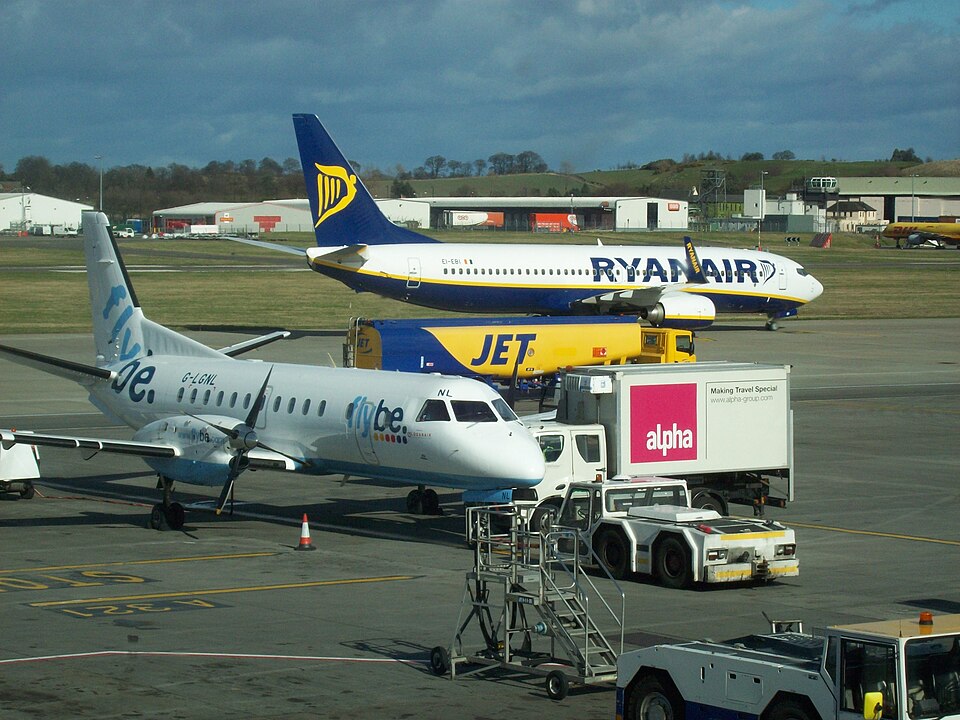
A Saab-Scania SF340B, registration G-LGNL, serial number 340B-246, year of manufacture 1991, was involved in an accident. It was powered by two General Electric CT7-9B turboprop engines. The flight was a Commercial Air Transport (Passenger) operation with three crew members and 26 passengers. The commander, aged 46, held an Air Transport Pilot's Licence with 3,880 total flying hours (3,599 on type). No injuries were reported among the crew; one passenger received a serious injury.
History of the Flight
The aircraft was prepared for a flight from Stornoway Airport to Glasgow Airport. After taxiing to Holding Point A1 at 0825 hrs, it was cleared for takeoff from Runway 18 at 0832 hrs. The surface wind reported was from 270° at 27 kt. The commander noted the crosswind and that there was no tailwind. During the takeoff roll, the co-pilot applied almost full right aileron. As the commander advanced the power levers, the co-pilot called "autocoarsen high" and later "apr armed". Engine torques increased symmetrically, reaching 100% as the aircraft accelerated through 70 kt. Initially, left rudder maintained a constant heading. After rudder was centralised, a small heading change to the left and then to the right occurred, followed by a rapid left heading change. The aircraft deviated left and, despite right rudder input, skidded off the paved surface at 80 kt. The power levers remained at full travel. The aircraft crossed a disused runway and came to a halt with the nose landing gear collapsed, 38 m left of the runway edge and 250 m from where it first left the pavement. After stopping, the commander saw the propellers turning and instructed passengers to remain seated. A passenger opened the right over-wing exit after that propeller stopped, and passengers evacuated. The left propeller was still turning when rescue services arrived.
Information from the Crew
The commander had not flown for 14 days and reported a restless night. He elected to use Runway 18 instead of Runway 36. He decided to use 100% torque due to gusty crosswind conditions. During the takeoff, he moved his hand from the nosewheel steering to the control yoke when he felt sufficient rudder authority, after which the aircraft turned left "immediately and violently". He did not recall rejecting the takeoff or reducing power. The co-pilot recalled the loss of control occurred after handover at 60-80 kt. The cabin crew member stated the aircraft swung violently then became very rough. She heard the commander shout that propellers were turning and instructed passengers to remain seated.
Examination of the Accident Site and Aircraft
Tyre marks from all six wheels were visible from approximately 200 m after entering Runway 18. The tracks diverged left and departed the paved surface after another 100 m, continuing on grass for 250 m. The marks indicated the tyres were not rolling straight; the aircraft was yawing up to 14° to the right of its direction of travel just after entering the grass. This yaw angle remained until the disused runway, after which the aircraft was no longer yawed. The nose landing gear collapsed shortly after. The runway surface was grooved and in good condition. The aircraft suffered extensive damage: the nose landing gear broke off rearwards, both propellers struck the ground with outer portions broken, and the radome and lower forward fuselage sustained tears with mud and water ingress. No damage to the cabin, emergency exits, or seats.
Recorded Information
The aircraft was equipped with a 2-hour cockpit voice recorder (CVR) and a flight data recorder (FDR) that captured over 52 hours of operation. Parameters included lateral acceleration, heading, and rudder pedal/position. Nosewheel steering angle, wheel position, brake pressures, and groundspeed were not recorded. During taxi, a flight control check was performed with full deflections; right aileron was maintained throughout the takeoff roll with positions of -21.5° and +22°. Power levers reached full travel in five seconds with symmetric torque. Left rudder was applied until about 40 kt, after which heading initially decreased then increased before a rapid left turn. Right rudder was applied but the heading subsequently increased to 188° at 80 kt. Fluctuations in normal and longitudinal acceleration were recorded.