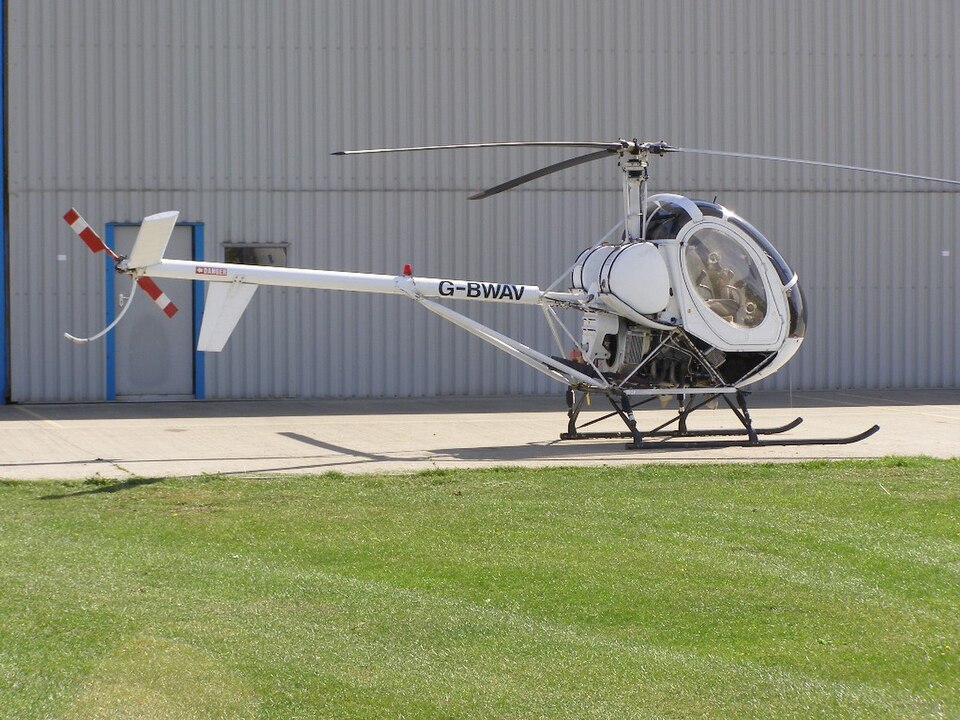
Accident Overview
On 12 June 2014 at 1640 UTC, a Schweizer 300 helicopter (registration G-BWAV, serial number S 1204, year of manufacture 1985) was destroyed in an accident at Dunsfold Aerodrome, Surrey. The aircraft was powered by a single Lycoming HIO-360-D1A piston engine. The private flight was being conducted by the sole occupant, a 65-year-old pilot holding an Airline Transport Pilot's Licence with approximately 13,000 total flying hours, including 250 hours on type. The pilot reported no injuries.
History of the Flight
The pilot was at Dunsfold Aerodrome to practice a display sequence in preparation for an upcoming air show at Biggin Hill. The weather was fine with a light westerly wind. After completing the practice manoeuvres successfully, the pilot decided to finish with a simulated engine failure and autorotation, culminating in a powered recovery. He entered the manoeuvre at 400 ft above aerodrome level (aal), simulating an engine failure at maximum display height.
He began by lowering the collective lever and then reducing engine rpm, before increasing engine rpm again in preparation for the powered recovery. He expected this would produce a split between engine and rotor rpm, with the engine at low rpm while the rotor rpm was maintained by airflow through the rotor disc during descent. During the descent, the pilot noticed an unusually small amount of right pedal was required. Checking the instruments, he realised that the engine and rotor rpm needles were not split—the engine was still linked to the rotor through the clutch system—and that rotor speed had decayed to 300 rpm. As the helicopter descended quickly, the pilot attempted to open the throttle further to increase engine rpm, though he was later unsure how much it may have increased. Because the rotor rpm were low, he did not raise the collective, as that would have aggravated the situation. He instead flared hard, but the helicopter struck the ground with force, severing the tail rotor and gearbox. The helicopter continued to tumble until it came to rest on its right side, pointing in the direction it had come from. The pilot's inertia reel shoulder harness straps failed in the accident, although he escaped without injury.
Additional Details
The pilot attributed the accident to his failure to ensure that a needle split had been achieved before committing to the practice autorotation, with the result that the lower engine rpm caused the rotor rpm to reduce. He believed that his relatively low height—400 ft aal—and attendant concentration outside the cockpit contributed to his error. He noted that he had successfully completed the same manoeuvre about 20 minutes earlier when starting from approximately 800 ft aal.