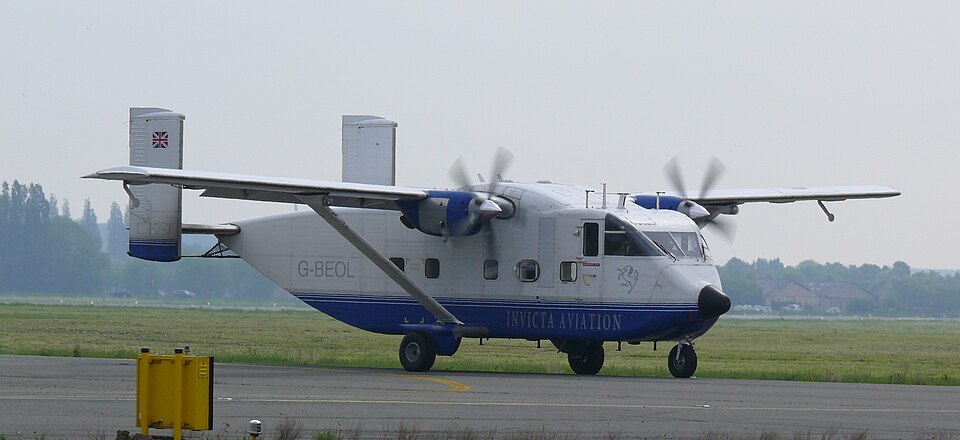
Incident Overview
On 3 May 2013, at 1320 UTC, the Short SC7 Skyvan 3, registration G-BEOL, experienced a detachment of its nose landing gear (NLG) components upon landing at Weston-on-the-Green, Oxfordshire. The event prompted a forensic investigation by the aircraft manufacturer into the failed components.
Investigation Findings
The manufacturer's technical investigation determined that the detachment resulted from a fracture of the sliding tube within the oleo of the nose landing gear. The sliding tube is a hollow component with an internal screw thread at its lower end for attaching the nose wheel fork assembly. The fracture occurred near the top of this thread, specifically around the undercut—a recessed area intended to provide clearance for the thread cutting tool.
The most likely mechanism leading to the failure was the propagation of a fatigue crack originating from a machining feature present on the surface of the thread undercut. This feature may have been caused by the dimensions and tolerances specified for the undercut diameter on the manufacturing drawing, which allowed the thread cutting tool to leave a mark on the surface. Additionally, cracks were observed in some thread roots, and fatigue initiating from these features could not be discounted as a contributing factor.
Safety Actions
In response to the findings, the manufacturer issued Service Bulletin (SB) 32-17M, which requires a one-off visual and non-destructive testing (NDT) inspection of all Short Skyvan NLG sliding tubes installed on aircraft and held as spares. These inspections were mandated by EASA Airworthiness Directive 2014-0246, effective from 26 November 2014. At the time of the bulletin, no further corrective actions were proposed, but the manufacturer stated it would monitor responses to the service bulletin and take additional action if necessary to maintain the continued airworthiness of the fleet.