History of the Flight
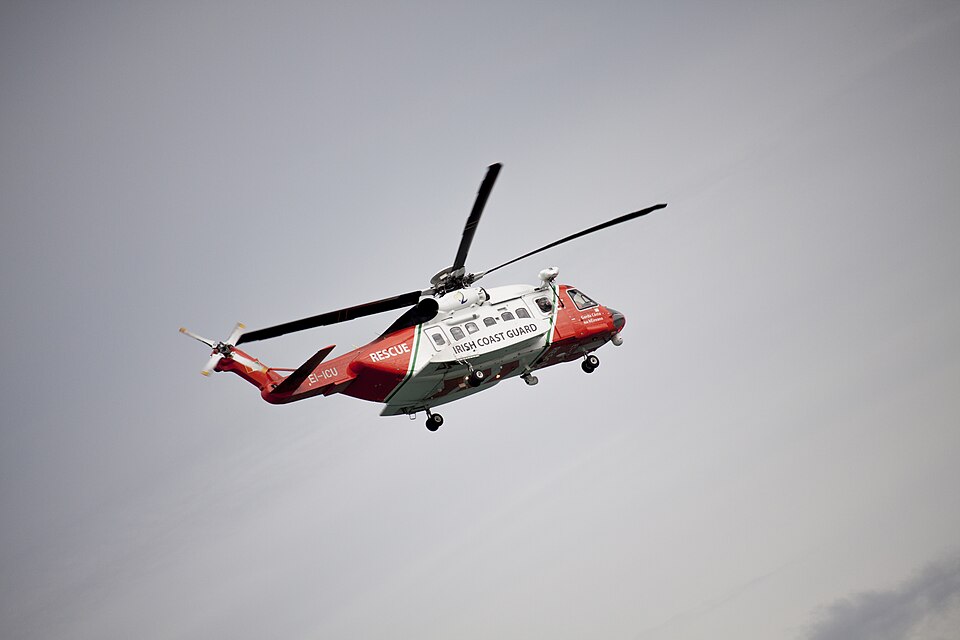
A Sikorsky S-92A, registration EI-ICU, departed Sligo, Ireland on a training exercise to rendezvous with a lifeboat near Portrush. The helicopter cruised at 2,000 ft amsl under visual meteorological conditions with two pilots and two rear crew. The weather forecast warned of occasional moderate turbulence up to 6,000 ft amsl along the north coast.
Approximately 5 nm east-northeast of City of Derry Airport, the helicopter encountered unexpected severe turbulence. The pilot reported a slight pitch increase followed by a pitch decrease and acceleration. Airspeed reached 175 KIAS, exceeding the never-exceed speed (VNE) of 165 kt, triggering an aural warning. The pilot raised the pitch attitude, reduced collective, and slowed to around 100 KIAS, then climbed to 2,800 ft amsl. All crew noted increased airframe vibration after the event. The pilots decided to divert to City of Derry Airport, notified ATC, and landed without further incident.
Recorded Information
The helicopter was equipped with a combined cockpit voice recorder and flight data recorder (FDR), plus a health usage monitoring system (HUMS). FDR data showed an eight-second pitch oscillation (Point A to B), with cyclic movement opposite to pitch changes. Airspeed then increased sharply; the pilot made a nose-up cyclic input (Point C) and lowered collective (Point D). Wind speed dropped significantly (Point E) during the acceleration, though direction remained constant. Altitude rose approximately 150 ft (Point F) as the pilot responded. Airspeed peaked about 25 kt above its initial value, then the helicopter slowed to 100 KIAS (Point G). Engine and rotor parameters remained normal throughout.
Aircraft Information
The Sikorsky S-92A is a twin-engine medium-lift utility helicopter used for search and rescue operations. EI-ICU was manufactured in 2006.
Meteorology
Weather was clear with no convective activity or low cloud. High pressure over the UK and a decaying frontal system near western Ireland brought south-westerly winds increasing during the day. The low-level significant weather chart included a warning of occasional moderate turbulence up to 6,000 ft amsl in the north. An aftercast indicated potential moderate mountain waves at 3,000 ft amsl in Northern Ireland, without rotor streaming, and a widespread elevated inversion promoting wave formation. At the event location, 5 nm east-northeast of City of Derry Airport, the helicopter was directly downwind of the Sperrin Mountains (highest point ~2,200 ft amsl) with wind at 210°/40 kt at 2,000 ft, perpendicular to the ridge. A satellite image at 1530 hrs showed weak mountain wave activity in the area. About two hours prior, an aircraft reported windshear on approach to Derry and executed a go-around.
Other Information
After landing, the commander visually inspected the helicopter with no obvious damage. The operator conducted an overspeed inspection, identifying three findings that were rectified by component replacement (stabilizer strut, aft tail drive shaft bearing support, forward tail drive bearing support). HUMS data showed no increased vibration during the flight. The manufacturer's field service representative believed the defects likely pre-existed the overspeed event.
Analysis
FDR data indicated the helicopter experienced a sudden wind change leading to pitch oscillations and acceleration. The FMS wind calculation lag likely caused the recorded wind drop to appear after the pitch changes. The crew's control inputs reduced speed, with a 150 ft climb during the overspeed. The relatively constant groundspeed suggested the airspeed increase was due to a wind change. The increased vibration noted by crew prompted the diversion. The helicopter likely flew through mountain wave activity from the Sperrin Mountains, creating turbulence with no visual cues. Moderate turbulence was forecast, but mountain wave activity was not explicitly predicted in the pre-flight briefing.