Incident Summary
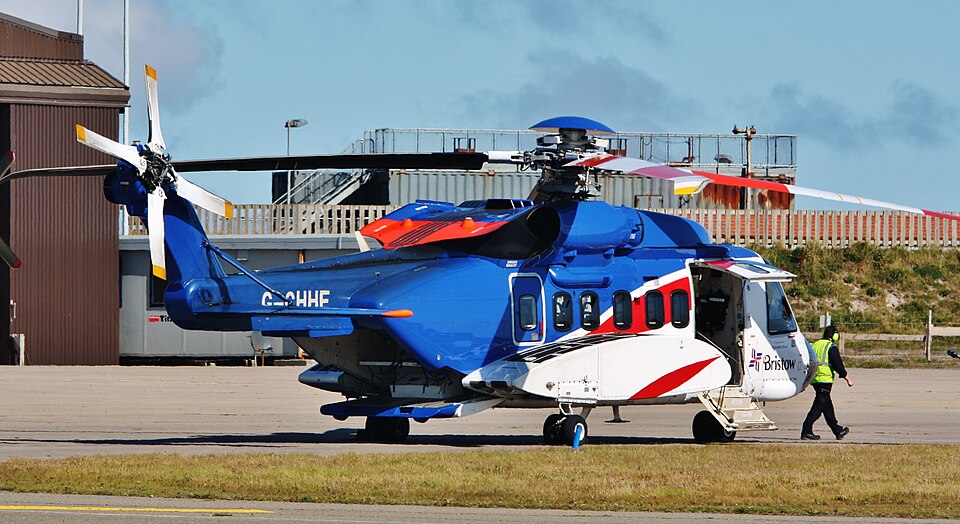
On 29 January 2018, a Sikorsky S-92A helicopter (registration G-CHHF) on approach to Scatsta Airport, Shetland, experienced a failure of the nose landing gear (NLG) to extend. The helicopter was completing a routine passenger flight from the Magnus offshore platform with two crew and 19 passengers on board. The main landing gear extended normally, but the NLG remained retracted. The crew recycled the gear and twice attempted the emergency blowdown extension, but the NLG did not lower. A PAN was declared, and engineering advice was sought.
Aircraft and Flight Details
The helicopter, manufactured in 2011, was powered by two General Electric CT7-8A turboshaft engines. The commander held an Airline Transport Pilot's Licence with 8,332 total flight hours, including 4,439 on type. The type of flight was commercial air transport (passenger). No injuries were reported among crew or passengers, and no damage occurred.
Emergency Response
After declaring a PAN, the crew flew a low-level circuit to allow ATC to visually confirm the NLG status. Engineering advice led to a decision to attempt external manual release. The helicopter was hover-taxied to the apron with emergency services standing by. The pilot held the helicopter with mainwheels on the ground and nose raised. An engineer approached and observed that the nosewheels were not centred. Using a lever, he realigned the wheels, allowing the NLG to extend and lock. The helicopter was then settled on the ground, a safety lock fitted, and it was shut down without further incident.
Engineering Investigation
The helicopter was withdrawn from service and placed on jacks. Retraction checks initially showed the nosewheels did not self-centre, but after several cycles they centred and functioned normally. The operator replaced the complete NLG assembly and returned the removed unit to the manufacturer for examination. The examination revealed the NLG was in good overall condition but showed evidence of leakage around the hydraulic port, with 3,250 ml of hydraulic fluid drained (correct quantity 3,890 ml). The lower cylinder cap was not tightened to correct torque, and the NLG had oily/dirty deposits. The exact cause of the centring mechanism failure could not be identified. After rebuilding and testing, the self-centring mechanism operated correctly.
Manufacturer's Experience
The helicopter manufacturer had investigated six previous reports of NLG off-centre and jammed in the wheel well. These were attributed to improper servicing, specifically low oil or nitrogen charge in the strut preventing the self-centring cams from interlocking. In September 2017, the manufacturer issued a letter to operators highlighting this issue and the importance of correct fluid and gas charge.
Operational Considerations
The crew followed the operator's Emergency Operations Procedure (EOP) 8/3, 'Landing Gear Will Not Extend,' but noted that this procedure did not lead into actions from EOP 8/2, which covers landing with gear retracted. The crew opted for external manual release due to available expertise and time. The operator acknowledged that EOP 8/3 needed clearer direction to EOP 8/2, and subsequently amended and reformatted the procedures as EOPs 13/2 and 13/4.
Conclusion and Safety Actions
The exact cause of the NLG failure to centre the nosewheels could not be determined. The operator took safety actions: reiterating the manufacturer's September 2017 letter to engineering staff, reminding crews to ensure nosewheels are not canted off-centre before takeoff, and revising the EOPs to draw attention to actions for safe landing with gear retracted or asymmetric.