History of the Flight
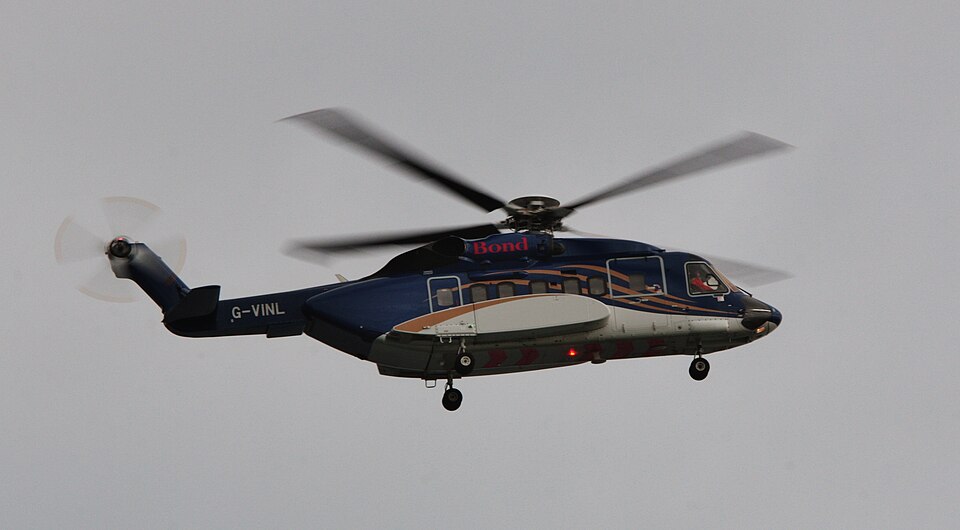
On 22 August 2014, a Sikorsky S-92A helicopter (registration G-VINL) was conducting a multi-sector commercial passenger flight from Aberdeen Airport to offshore rigs in the North Sea. The crew consisted of two pilots and one passenger. The flight was planned to visit the Scott platform, the Paragon MSS1 semi-submersible rig, and the Buzzard complex before returning to Aberdeen.
After an uneventful departure and sectors to Scott and Paragon MSS1, the helicopter landed on the Paragon MSS1 helideck. While on deck, the co-pilot experienced difficulties obtaining passenger payload information from the Buzzard Log operator. The crew became distracted by conflicting radio transmissions regarding the return loads for their helicopter and another company helicopter.
For the next sector to the Buzzard complex, the crew identified a large grouping of platforms ahead as the Buzzard complex. They decided to fly manually at 500 ft amsl without using the Flight Management System for navigation. The takeoff was uneventful, and the commander turned the helicopter towards the target.
During the short transit, the co-pilot requested deck availability from the Buzzard HLO and received confirmation. The crew performed the Final Approach checklist, but the helideck name was not visible initially. Upon landing, the commander saw the helideck name 'ENSCO 120' in his rear quarter, realizing they had landed on the wrong helideck—the Golden Eagle complex instead of Buzzard.
The crew immediately informed the Ensco 120 Log operator of the error. The commander decided to take off without delay, as there were no obstructions and the helicopter had performance margins. After briefing the passenger, they conducted full pre-departure checks and used the FMS to identify the correct location of the Buzzard complex. The helicopter then departed and landed at the Buzzard complex without further incident.
Meteorological Information
The flight was conducted in daylight with good weather outside rain showers. At the time of the incident, the surface wind was from 330° to 340° magnetic at 15–20 kt, visibility was greater than 10 km, and scattered cloud was present at 1,800 ft. Moderate rain in the vicinity of the Buzzard complex obscured it from the crew during earlier sectors.
Helideck Information
The Buzzard complex consists of three fixed platforms with the helideck on the southwestern end, oriented approximately 050°/230° magnetic. It lies 7 nm on a bearing of 205° magnetic from Paragon MSS1. The Golden Eagle complex comprises two fixed platforms with a helideck on the Ensco 120 jackup rig attached to the northern side. It lies 3 nm on a bearing of 354° magnetic from Paragon MSS1. Both helidecks held valid certification from the Helideck Certifications Agency.
The crew misidentified the Golden Eagle complex as the Buzzard complex, leading to the incorrect landing.