History of the Flight
The student pilot had completed a dual circuit consolidation flight with an instructor immediately before the accident flight. The instructor assessed the student's performance as satisfactory and exited the aircraft on the parking area. The student then intended to practice circuits solo.
The student taxied to Runway 25 after making a radio call to Blackbushe Information. Engine run-up checks showed no abnormalities. After holding at point A1 for Runway 25 and making a ready-for-departure call, the student was cleared for takeoff at his discretion. He lined up, increased engine rpm to 4,000, checked temperatures and pressures, and released the brakes. As the aircraft accelerated, he recalled applying right rudder and advancing the throttle to maximum continuous power. He stated that as airspeed became live and he advanced to maximum takeoff power near rotation speed (approximately 55 kt), the aircraft veered left. He attempted additional right rudder, which felt stiffer than usual.
The aircraft exited the runway onto adjacent grass. The student reduced throttle to idle and the aircraft underwent several bounces. He applied brakes but could not recall effectiveness. While traveling across the grass, he saw a large antenna ahead. Right rudder had no effect; left rudder gave a response, but he could not avoid the antenna. The right wing struck the antenna, and the aircraft rotated around it, coming to rest after almost 270° of yaw, approximately parallel to Runway 07. The antenna collapsed onto the aircraft, shattering the canopy.
After the aircraft stopped, the student released his harness and opened the canopy. A bystander called to vacate due to leaking fuel. The student turned off magnetos, removed the key, turned off master switches, and vacated over the left wing. His phone detected the crash and initiated an emergency call at 1538 hrs. The student was admitted to hospital with a serious chest injury (manubriosternal dislocation), believed from colliding with the control yoke, and remained for five days.
Aircraft and Personnel Information
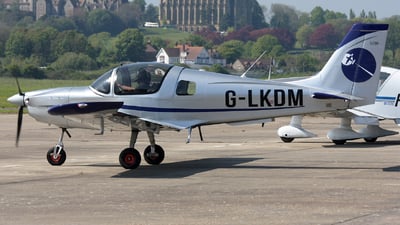
The aircraft was a Sonaca 200 (G-LKDM), a low-wing cantilever monoplane powered by a 115 hp Rotax 914 engine with a fixed tricycle landing gear. It was manufactured in 2022 (serial no. 056). The student pilot, aged 23, held a student licence and had 20 flying hours total, all on type, with less than one hour as pilot-in-command. The instructor noted that the student demonstrated a high level of aircraft control during the preceding circuits and had a tendency to verbalize actions.
Accident Site
The aircraft struck an antenna adjacent to the Blackbushe Non-Directional Beacon (NDB) and came to rest opposite the intended departure direction. The right wing was severely damaged, the canopy shattered, and the nose landing gear broke off. The aircraft was damaged beyond economic repair.
Meteorological Information
Wind at the time was reported as from 250° at 9 kt, aligned with the departure runway (25), so crosswind was not a factor.
Conclusions
The aircraft yawed left and exited the runway, most likely as a result of uncorrected slipstream and torque effects. It is possible that the student suffered a startle response that affected his response. The available evidence suggested insufficient right rudder was applied. The aircraft was damaged beyond economic repair, and the student suffered a serious chest injury.