History of the Flight
Following an experience flight in the local area, the Spitfire, registration G-CTIX, landed on Runway 24L at Duxford Aerodrome. The pilot received taxi instructions to a parking position northeast of the Eastern Apron. After crossing the grass runway onto the paved taxiway, Air Traffic Control instructed the aircraft to hold position due to conflicting traffic under tow. Once that traffic passed, G-CTIX was cleared to continue taxiing. The pilot noted a Bearcat aircraft preparing for departure to the right of the taxiway.
Works were in progress to extend the public area on the Eastern Apron, reducing available apron parking space but leaving the taxiway fully usable. A Flight Information Service Officer (FISO) familiar with Duxford commented that normally the full apron area would be used by taxiing aircraft to pass traffic holding at Holding Point A. A NOTAM regarding the reduced apron size had expired two days before the event and was not extended by those performing the work.
The pilot stated he had recently become mindful of carbon monoxide exposure from the engine exhaust while taxiing with the canopy open. On this occasion, he chose to taxi with the canopy closed, the first time he had done so.
In a taildragger like the Spitfire, weaving from side to side during taxi is normal to see along the intended route. As the pilot prepared to leave the main taxiway and enter the parking area to the left, he turned the aircraft right away from a barrier. During the reverse turn, he saw a PA-28 forward of the right wing at the A24 holding point, facing northeast. The PA-28 pilot could not have seen the Spitfire approaching.
Upon sighting the PA-28, the Spitfire pilot applied full left rudder and brake. The Spitfire swung left, and its right wing contacted the left wing of the PA-28. The Spitfire pilot stopped the aircraft, shut down the engine, and signaled the PA-28 pilot to do likewise. He checked on the occupants. Airfield emergency services attended, as did staff from the experience flight who helped the passenger disembark. Both aircraft sustained minor cosmetic damage, and no injuries were reported.
Aircraft Information
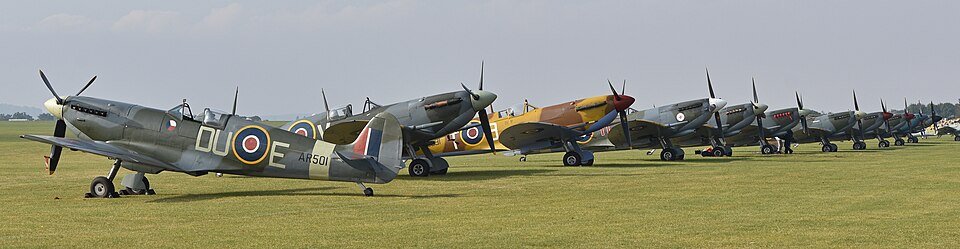
Originally built as a single-seat aircraft in 1944, G-CTIX is a monoplane with conventional landing gear, restored to flying condition in 1987. During restoration, it was modified to a two-seat configuration. This places the pilot seat further forward than originally, but the view ahead remains substantially obscured by the aircraft's nose.
Discussion
Duxford Aerodrome provides an Aerodrome Flight Information Service (AFIS). The AFISO on duty believed there was sufficient room for the Spitfire to follow its cleared taxi route while the PA-28 conducted its checks. The pilot had not been advised of the PA-28 holding at A24. The AFISO commented that no other appropriate location exists for pre-flight checks prior to departing Runway 24.
An investigation by the aerodrome operator determined that appropriate traffic information was not passed to the pilot of G-CTIX. The report recommended issuing an operational reminder to AFISOs to pass traffic information to taxiing aircraft, particularly taildraggers.
The pilot, familiar with Duxford, stated he ordinarily receives traffic information from the AFISO. He considered the works along the cleared taxi route left insufficient room to follow the cleared route. While ultimate responsibility for safe operation lies with the pilot, the AFISO service can assist in maintaining awareness of traffic and obstacles.
The pilot noted that taxiing with the canopy closed reduced his view from the cockpit, implying more pronounced turns might be necessary to check the way ahead. He also commented that activity beside the active taxiway for the public area extension was a significant distraction.
The NOTAM advising of the reduced apron size was not valid at the time. Had it been extended, the FISO and pilot would more likely have been aware of the reduced apron and ongoing works. The aerodrome operator stated that, in response, it issued an Operational Notice to all ATC staff requiring completion of a new form, 'Eastern Apron Usage Requests', before approval of future works, and that a temporary fence line be assembled to leave a clear space around Holding Point A.
Conclusion
The temporary reduction of the movement area without a valid NOTAM, the pilot's decision to taxi with the canopy closed to reduce exhaust exposure, and the lack of traffic information provided to the pilot by the AFISO, contributed to the loss of separation between the aircraft on the ground. The aerodrome operator has issued an Operational Notice reminding AFISOs of the restricted visibility experienced by pilots of taildragger aircraft and the benefit of passing traffic information to taxiing aircraft.