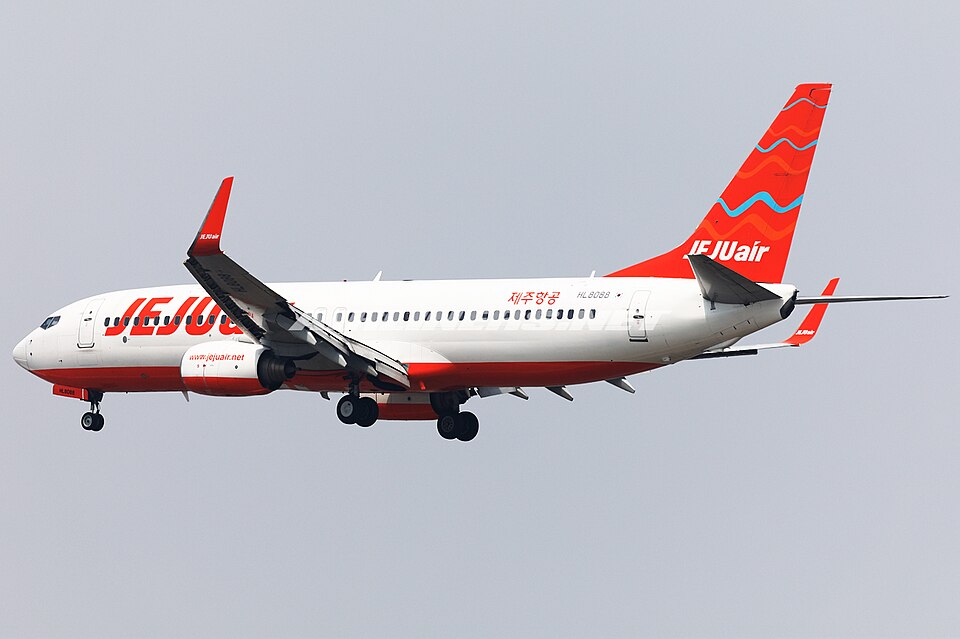
Accident Overview
On Sunday, December 29, 2024, at 09:03 local time (00:03 UTC), Jeju Air flight 7C2216, a Boeing 737-800 registered as HL8088, crashed while attempting to land at Muan International Airport (RKJB). The aircraft had departed from Suvarnabhumi International Airport (VTBS) in Thailand at approximately 04:30 local time with 181 people on board: 6 crew members and 175 passengers.
History of Flight
HL8088 first contacted Muan tower at 08:54:43 and was cleared to land on runway 01. At 08:57:50, the tower warned the crew about bird activity. Both the cockpit voice recorder (CVR) and flight data recorder (FDR) stopped recording at 08:58:50. Seconds later, at 08:58:56, the crew declared a mayday three times, citing a bird strike during a go-around. The aircraft flew over the left side of runway 01, then turned right and aligned with runway 19. The airplane then belly-landed without its landing gear deployed, overran the runway, and crashed into an embankment—including the localizer installation—before bursting into flames.
Injuries and Damage
The accident resulted in 179 fatalities: 4 crew members and 175 passengers. Two crew members sustained serious injuries. The aircraft was destroyed. A fire and partial explosion occurred upon impact. Both engines were buried in the embankment's soil mound. The forward fuselage scattered 30 to 200 meters from the embankment, while the empennage flipped and came to rest beyond the embankment, partially burned.
Wreckage and Impact Details
The wreckage was located at approximately 34° 58′ 35.28″ N, 126° 22′ 58.41″ E. The impact occurred at 09:02:57, meaning the last 4 minutes and 7 seconds of the flight were not recorded by the CVR or FDR. At the time the recorders stopped, the aircraft's speed was 161 knots and its pressure altitude was 498 feet.
Pilot Information
The captain had 6,823 total flight hours, with 6,096 hours on the Boeing 737 and 2,559 hours as pilot-in-command on the 737. The first officer had 1,650 total flight hours, with 1,339 hours on the 737. In the 90 days before the accident, the captain flew 186 hours and the first officer 164 hours.
Weather Conditions
A METAR issued at 00:00 UTC on December 29 reported wind from 110° at 2 knots, visibility 9,000 meters, few clouds at 4,500 feet, temperature 2°C, dew point -0°C, and atmospheric pressure 1028 hPa. No significant weather changes were expected.
Bird Strike Evidence
The pilots reported seeing a group of birds while approaching runway 01. Security camera footage showed HL8088 coming close to a flock of birds during the go-around. Feathers and bird blood stains were found on both engines. DNA analysis by a domestic organization identified the bird species as Baikal Teals.
Black Box Analysis
The CVR and FDR stopped recording at 08:58:50, approximately 4 minutes before impact. The recorded flight path from takeoff to that point is shown in Figure 2 of the preliminary report. The investigation is ongoing.
Investigation Plans
The Aviation and Railway Accident Investigation Board (ARAIB) will conduct engine teardowns, component examinations, and analysis of CVR/FDR and air traffic control data. The embankment, localizers, and bird strike evidence will also be investigated. Assistance is being provided by the U.S. National Transportation Safety Board and the French Bureau d'Enquêtes et d'Analyses pour la Sécurité de l'Aviation Civile.