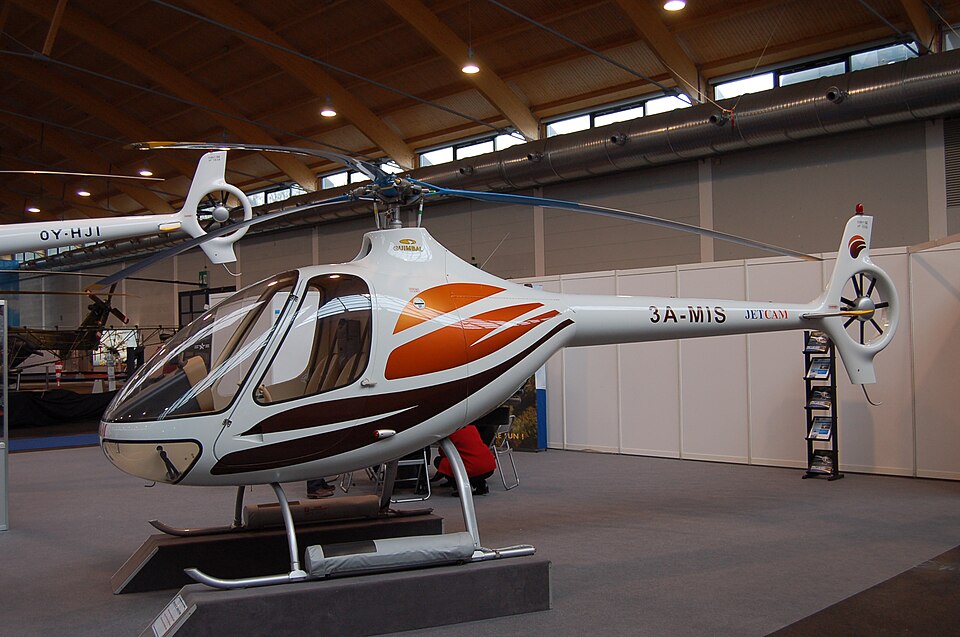
On November 11, 2015, a Guimbal G2 Cabri (registration 3A-MIS) was involved in an aviation accident near Aix-les-Milles (13), FR. Investigators recorded the probable cause as: The instructor likely did not maneuver the throttle handle to its stop, leaving the collective pitch and engine power coupling active. This summary draws on records from the French Bureau d'Enquêtes et d'Analyses (BEA).
A Guimbal G2 Cabri (3A-MIS) left the taxiway during a simulated engine-failure landing on 11 November 2015, causing rotor-tail interaction and heavy damage.
Incident Overview On 11 November 2015 at approximately 11:45 local time, a Guimbal G2 Cabri helicopter, registration 3A-MIS, was involved in an accident at Aix-les-Milles aerodrome. The aircraft was operating a general-aviation training flight with an instructor and a student on board. The helicopter sustained heavy damage. ## Flight Sequence The student and instructor departed around 11:15 for a training flight intended to obtain a type qualification. After completing a circuit and practicing engine-failure hover exercises in ground effect, the instructor took the controls to demonstrate an engine failure during takeoff. The helicopter accelerated to about 20 knots at a height of 5 feet above the ground. The instructor simulated the failure by reducing engine power using the rotating handle on the collective control. During the skid landing, the helicopter yawed left by about 30 degrees, left the taxiway, and bounced one or two times in the grass. The main rotor blades severed the tail boom, and the helicopter rotated 90 degrees to the right before coming to rest. ## Aerodrome and Weather The accident occurred on a taxiway west of runway 14/32, which is 1,504 meters long and 30 meters wide. The taxiway used was 15 meters wide. Estimated weather conditions at the site were calm wind, visibility over 10 kilometers, few clouds with some low stratocumulus, and a temperature of 11 degrees Celsius. ## Investigation Findings The flight manual procedure for a takeoff engine failure includes using left pedal to counter right yaw, aft cyclic to level the helicopter, and raising the collective to cushion contact with the ground. The student had 2,600 flight hours, and the instructor had 3,400 hours, including 180 on type. The instructor noted limited experience with this specific exercise. During the skid landing, the instructor was unable to control the helicopter in yaw. The helicopter quickly left the taxiway, and irregularities in the grass strip caused bounces that interfered with the instructor's ability to maintain neutral cyclic. The student reported that the landing was flat and not hard, but the helicopter yawed left sharply at ground contact. The instructor attempted right rudder input without success. A few days after the accident, the instructor repeated the exercise with another instructor and observed a left yaw movement at ground contact. It was found that during the power reduction to simulate the engine failure, the pilot had not correctly positioned the throttle handle to its stop. In normal operation, the collective pitch control is coupled to engine power. Increasing collective pitch increases engine power and causes a left yaw movement due to torque effect. This coupling is inhibited by turning the throttle handle to idle until it reaches its stop. ## Probable Cause It is probable that the instructor did not maneuver the throttle handle to its stop, leaving the coupling between collective pitch and engine power active. When the pilot raised the collective to cushion the ground contact, the helicopter yawed unexpectedly, and the instructor was unable to counter it. After leaving the taxiway, the bounces likely caused main rotor tilts that the pilot could not control, resulting in the rotor blades severing the tail boom. The investigation could not determine the pilot's actions on the flight controls during the skid. Conducting the exercise on a larger, smoother surface would have minimized the consequences of the yaw control loss.