History of the Flight
The flight originated on 8 August 2019 from Grimbergen aerodrome in Belgium, bound for Olbia, Sardinia, with a pilot and a passenger. After a night stop at Castellet airport and a stop at Calvi-Sainte-Catherine airport where they refueled and added 0.5 l of oil, they departed at 15:14 under a VFR flight plan. The cruise altitude was around 2,000 ft, following the Corsican coast approximately 4 km to the west.
At 15:24, two bangs were heard about 15 seconds apart. Manifold pressure and speed decreased. About 30 seconds later, when about 2 km off île de Cargalo, the engine shut down. The pilot attempted to restart by selecting the right fuel tank, setting power to full, checking the mixture, turning on the electric pump, and engaging the starter, but the engine did not restart. He adopted the best glide speed of 110 kt, while the passenger made two distress calls on the Ajaccio information frequency that went unanswered. At 1,200 ft, the pilot decided to ditch with landing gear and flaps retracted, heading toward the coast near pleasure boats.
The pilot turned to ditch parallel to the coast. While preparing to flare with flaps and gear retracted, the airplane stalled about ten meters above the water. The right wing and nose struck the surface. The airplane then stopped momentarily with a nose-down attitude of about 45°, the forward fuselage half submerged. Under the weight of the engine, it rapidly sank as boats arrived to assist. The occupants, not wearing life jackets, released their seat belts as water filled the cockpit. The passenger opened the door when the cockpit was sufficiently full of water. Both evacuated and rose to the surface, swimming to boats where they were taken care of by amateur sailors.
Persons on Board
The pilot held a Private Pilot License (PPL(A)) issued in 2003 and an instrument rating from 2009, with about 645 total flight hours including 37 hours on OO-JBM in the previous three months. He reported that before the flight at Calvi, he prepared the interior while the passenger inspected the exterior; the stall warning was not checked. After the engine shutdown, he confirmed the alternator and battery selectors were ON. He did not squawk 7700 or manually activate the emergency locator transmitter. He did not recall feeling buffet or hearing the stall warning before the stall. He broke his jaw on impact. He was a good swimmer and wore clothes that did not hinder swimming.
The passenger held a PPL(A) since April 2017, with 1,388 flight hours (at least 22 in the previous month). During preflight at Calvi, he checked the oil level (9.5 l, added 0.5 l) and observed no signs of oil leaks. He was not certain the stall warning was checked. He did not hear the warning or feel vibrations before the stall. During the descent, he managed the radio, unlocked the front right door handle at the pilot's request, and held the door half-open until water impact. He sustained first-degree burns from swimming into a fuel slick. He was nearly drowning when rescued, but not hypothermic. He was not a strong swimmer.
Aircraft Information
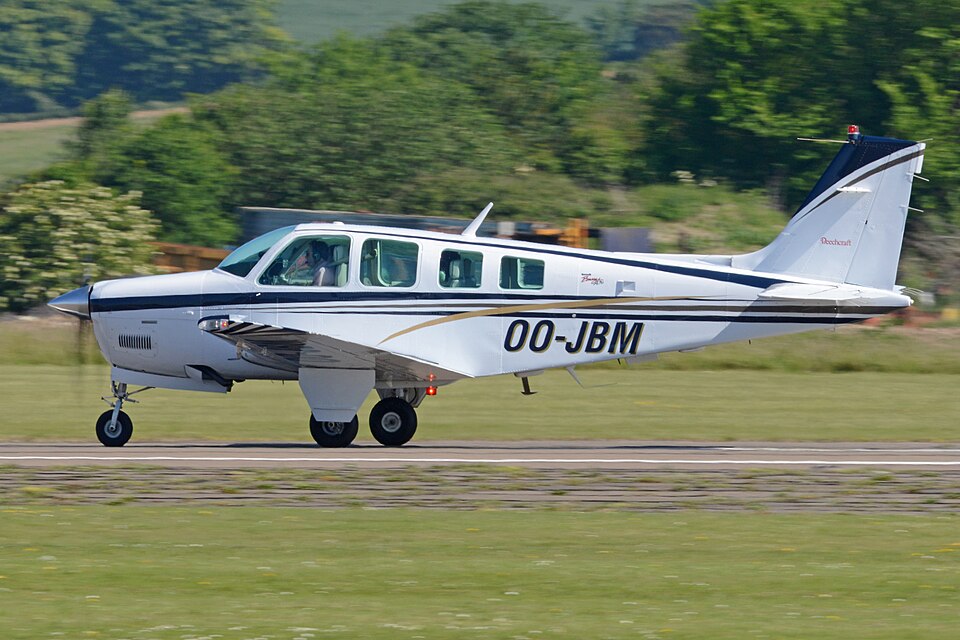
The airplane was a Beechcraft Bonanza A36 registered OO-JBM, equipped with a Continental IO-550-B six-cylinder engine installed in 1999, with about 1,388 hours at the time of the accident. Maintenance history included replacement of rocker-cover seals on the right side in November 2017 and left side in April 2018 due to oil leaks. Oil marks reappeared on the left side after flights in June and July 2019. On 17 July 2019, the left-side seals were replaced again, with the mechanic noting dry seals and drops of oil. No overconsumption of oil was observed after that. A minor maintenance on 2 August 2019 did not include the overdue 50-hour inspection (due at 1,375 hours; not carried out). The pilot did not realize the inspection was overdue.
During the engine shutdown, no oil splashes were seen on the canopy, and the propeller windmilled. The investigation could not determine the cause of recurrent oil leaks, and the possibility of incorrect seal installation could not be confirmed without engine examination. The overdue inspection could not be associated with the shutdown. No other anomalies were found in maintenance documents.
The center of gravity was within limits. The flight manual gives a maximum lift-to-drag ratio of about 10 at 110 kt flaps retracted and recommends 85 kt for engine-out landing, with flap and gear extension after landing assured. No specific ditching procedure is in the manual. The pilot's checklist did not include ditching or forced landing procedures, nor approach or stall speeds in clean configuration. The passenger's checklist listed 90 kt with flaps and gear retracted. The stall warning is inoperative if alternator and battery switches are off.
The wreckage sank 500 m south of Girolata headland at 60 m depth and was not located during a dive in December 2019. Witnesses noted a strong fuel smell on the water, indicating a non-negligible amount of fuel remained.