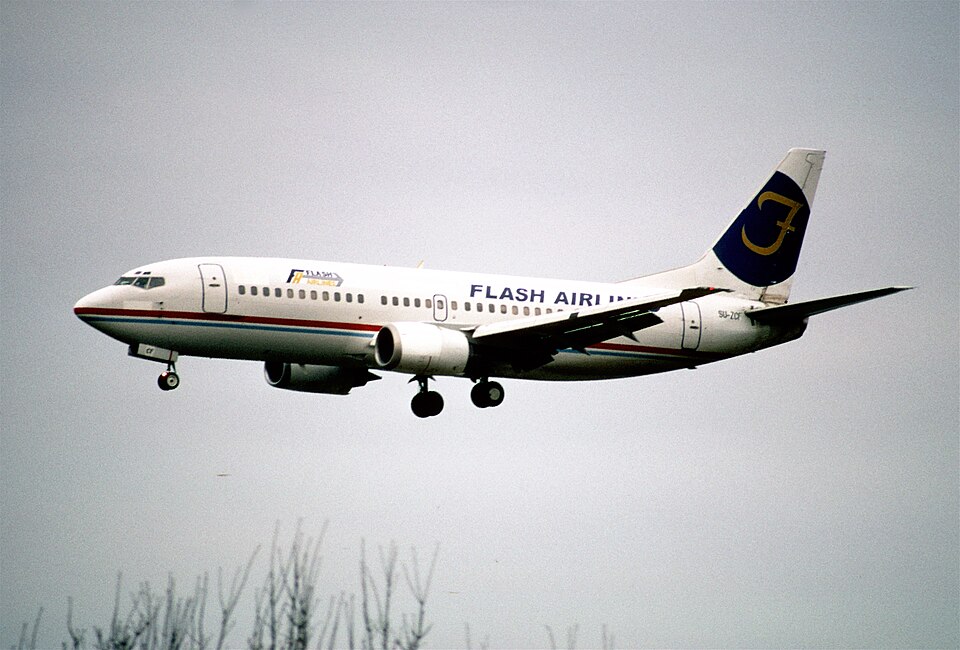
What happened
On January 3, 2004, a Flash Airlines Boeing 737-300, registration SU-ZCF, crashed into the Red Sea shortly after departing Sharm el-Sheikh International Airport. The flight was a passenger charter service destined for Paris via Cairo, carrying 135 passengers and 13 crew members.
After taking off from runway 22R, the aircraft began a climbing left turn as cleared by air traffic control. During the climb, the captain requested the engagement of heading select mode. While the aircraft was climbing, a transition in the autopilot mode occurred, which resulted in the loss of the heading select mode. Following this transition, the autopilot disengaged, triggering an audible warning in the cockpit.
Immediately following the autopilot disengagement, the aircraft began an uncommanded right turn. The flight crew attempted to re-engage the autopilot and manage the bank angle, but the aircraft entered a severe right bank that eventually exceeded 110 degrees. As the aircraft pitched nose-down, the airspeed increased rapidly to 416 knots. The aircraft impacted the water at approximately 02:45:06 UTC. There were 148 fatalities and no survivors.
The investigation
The investigation examined the flight data recorder (FDR) and cockpit voice recorder (CVR) to reconstruct the sequence of events. Investigators analyzed the aircraft's automation systems, specifically the autopilot and flight director, to understand the mode transitions. The investigation also reviewed the aircraft's weight and balance calculations, maintenance records, and the flight crew's performance during the emergency. Additionally, the investigation looked into the air traffic control procedures at Sharm el-Sheikh, noting the absence of standard instrument departures (SIDs) in the region.