History of the Flight
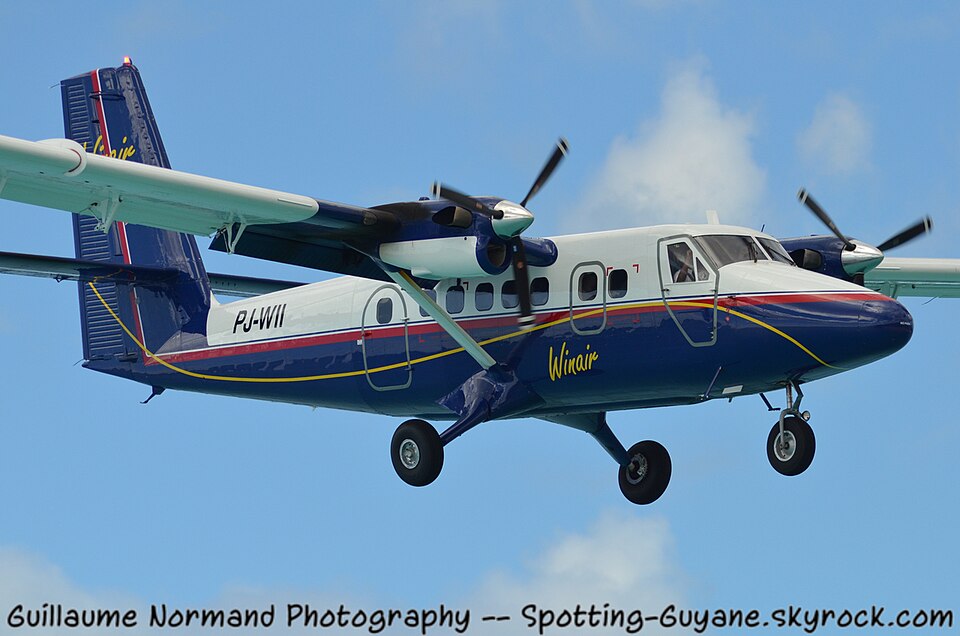
On 13 February 2019, a De Havilland DHC-6-300, registration PJ-WII, operated by Windward Island Airways International, departed from Saint Martin Princess Juliana Airport (Sint Maarten) for a passenger commercial flight to Saint-Barthélemy. The aircraft carried a crew of two (captain and co-pilot) and four passengers. It landed on runway 10 at approximately 14:45 local time and taxied to apron position P2 in front of the terminal. At that time, no other aircraft were maneuvering in the movement area, and the day's aerodrome activity was in a lull.
During taxi, a marshaller positioned herself on the apron to guide the crew. Following her hand signals, the crew taxied to the apron position, stopped, and set the parking brake. The crew then feathered the propeller blades of both engines. The marshaller placed chocks around the nose gear wheel on the left side of the aircraft's nose. She then walked around the front of the Twin Otter, turned to make a gesture to an acquaintance in the terminal building, and walked backwards down the right side of the airframe while looking away. The anti-collision light remained operating. As she passed the right engine propeller, which was still rotating, a blade struck her head, causing serious injuries.
Additional Information
Aerodrome Information
Saint-Barthélemy Airport has a single paved runway 10/28, 646 meters long. Apron positions P1–P4 in front of the passenger terminal are reserved for commercial air transport. Use of these positions is limited to 20 minutes during the day. At peak times, handling capabilities are frequently saturated, creating time pressure for ground personnel.
Aircraft Operator Information
Windward Island Airways International N.V. (Winair) is a commercial operator based in Saint Martin. It operated a fleet of three De Havilland Twin Otter DHC-6 aircraft. During SAFA inspections, remarks were addressed to the operator regarding ground agents walking near aircraft with propellers moving or anti-collision lights on. Personnel indicated this was done "to save time."
Ramp Agent Information
The ramp agent had been employed by a ground handling company for approximately nine months and was current with required training. At the time of the event, she was not wearing head protection; regulations did not mandate such equipment. Blood samples taken after the accident revealed consumption of alcohol and other psychotropic substances the previous night. Several statements indicated she had gone to bed late.
Aircraft Information
The De Havilland DHC-6-300 is a high-wing twin-engine turboprop with two Pratt & Whitney PT6 engines. The lowest point of the propeller disk is 1.37 meters above the ground.
Ground Operational Procedures
The Winair Ground Handling Manual outlines that after propeller feathering, engines continue to operate for about 10–20 seconds. The parking procedure requires ground personnel to place chocks, signal the captain, who then shuts down engines and switches off anti-collision lights, after which cones are placed when propellers are fully stopped. The manual identifies complacency, non-compliance with procedures, and environmental pressure as factors contributing to accidents.
The Saint-Barthélemy airport operator's safety booklet recommends waiting for propellers to stop before moving near aircraft and advises marking the aircraft footprint with cones. It notes that the only compulsory safety equipment is a high-visibility jacket; other protective gear is recommended but not required.
Conclusions
After positioning the nose gear chocks, the marshaller began walking around the aircraft without waiting for the anti-collision lights to be turned off and without maintaining a safe distance from the propeller danger zone. She became distracted and did not look in her direction of travel, approaching the right engine while it was still rotating. The propeller blades struck her head, causing serious injury.
Contributing Factors
The following factors may have contributed to the accident:
- Non-compliance with safety measures for moving around an operating aircraft.
- Probable fatigue due to late hours the previous night and probable consumption of psychoactive substances.
- Acquired habit among some ground personnel to disregard safety measures during short stops to save time.
Measures Taken by the Airport Operator
Shortly after the accident, the Saint-Barthélemy airport operator issued a memorandum to all users reminding them of the dangers of moving around the apron, the need for personal protective equipment, safe distance from engines until propellers stop, and the requirement for operators to establish clear ground safety policies. These topics were also addressed in regular meetings.
The BEA investigations are conducted with the sole objective of improving aviation safety and are not intended to apportion blame or liability.