History of the Flight
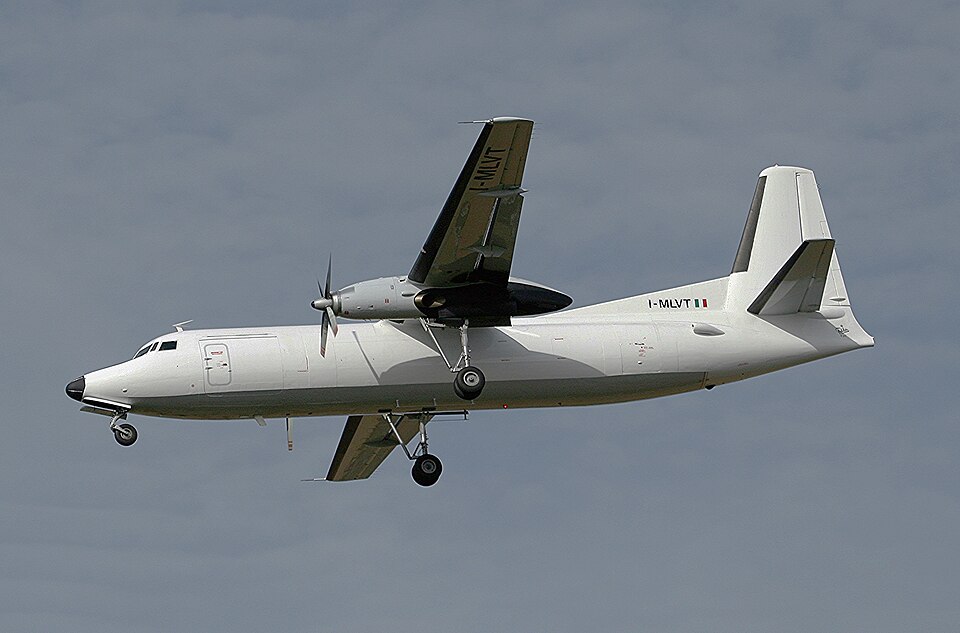
The crew of Fokker 27-500 registration I-MLVT, operated by Miniliner as a public transport cargo flight, took off from runway 09R at Paris-Charles de Gaulle Airport at 01:22 local time. At approximately 1,300 ft in altitude, the crew heard an explosion from the cargo area and observed illumination of the left 'engine fire' indicator light accompanied by an aural warning. They declared an emergency and initiated the engine fire procedure, but the feathering control was stuck. The captain looked out and saw that the fire had extinguished and part of the left engine was missing. The aircraft remained controllable, and the crew turned back for an emergency landing at Paris-Charles de Gaulle without further incident.
Examination of the Aircraft
The aircraft was equipped with two Rolls-Royce Dart 532-7 engines. The forward section of the left engine, including the propeller, was absent, and fire traces were visible on the rear of the engine nacelle. The fuselage had a vertical hole on the left side, from outside inward, and a similar hole on the right side, from inside outward. The postal freight container between the two holes was cut from side to side, and electrical cable bundles along the side walls were severed.
The separated components were found in a field directly beneath the initial climb path. Two propeller blades (Nos. 3 and 4) remained attached to the engine; blade No. 1 had separated but was retained by the de-icing cable; blade No. 2 was found about 600 m away.
Flight Recorder Data
I-MLVT carried magnetic tape flight recorders. The Flight Data Recorder (Sundstrand 4100) recorded the event flight but only altitude, indicated airspeed, heading, and vertical acceleration were valid; no engine variables were recorded. The recording stopped during initial climb at about 1,300 ft. The Cockpit Voice Recorder (Sundstrand AV 557 C) contained 30 minutes of audio including the event flight, stopping during climb. Spectral analysis indicated nominal engine and propeller speeds from takeoff to recording end. The recorders' power cables were cut when blade No. 2 passed through the fuselage.
Propeller Blade Failure Analysis
The left propeller (Dowty Propellers R193/4-30-4/61) had four variable-pitch metal blades. Blade No. 2 separated from the propeller due to fatigue failure of its pre-load bolt, approximately 8.7 mm below the bolt head. Scanning electron microscopy revealed fatigue striations covering 40% of the bolt cross-section, with the remaining 60% showing ductile fracture dimples. The crack initiated on the leading edge side, with two secondary cracks indicated by ratchet lines. Porosities and a non-metallic manganese sulphide (MnS) inclusion were found near the initiation area.
The bolt material was S99 steel with slightly higher sulphur content (0.023 wt%) than the specified maximum (0.020 wt%). Bolts from blades 1, 3, and 4 showed no cracks and complied with specifications. The manufacturer noted that higher sulphur content increases crack initiation probability from inclusions, and that the bolt was manufactured in the 1960s before low-sulphur steel improvements.
Bearing Pre-Load Examination
Examinations of the bearings from blades 1, 3, and 4 were performed to assess pre-loading. No further details were provided in the source.