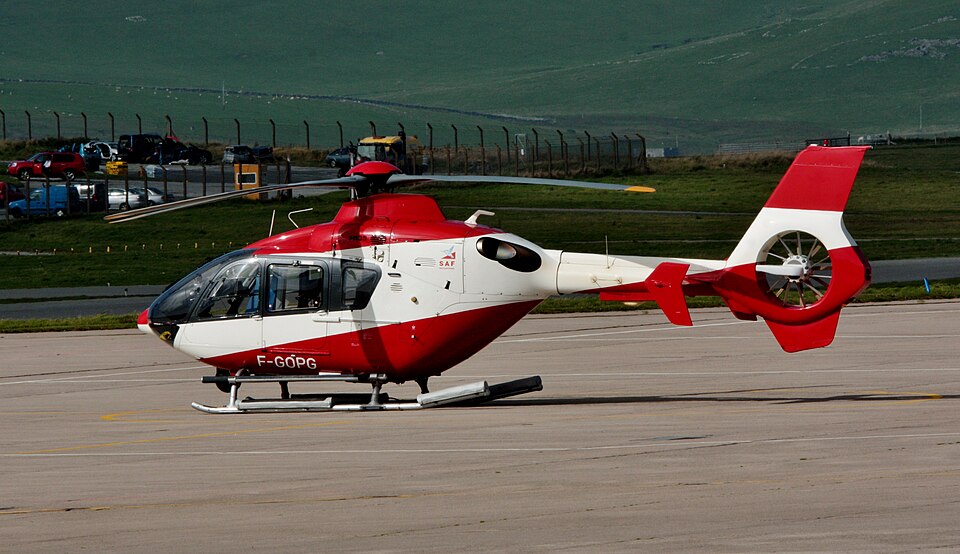
On February 13, 2018, a l’hélicoptère Airbus Helicopters EC135 T1 (registration F-GOPG) was involved in an aviation accident near Sainte-Foy-Tarentaise, FR. No fatalities were reported. Investigators recorded the probable cause as: Collision with a Catex cable during takeoff from a ski slope. This summary draws on records from the French Bureau d'Enquêtes et d'Analyses (BEA).
On 13 February 2018, an Airbus Helicopters EC135 T1 (F-GOPG) struck a Catex cable during takeoff from a ski slope in Sainte-Foy-Tarentaise, France, causing an emergency landing and damage to the helicopter.
Incident Overview and Immediate Sequence of Events On 13 February 2018, an Airbus Helicopters EC135 T1, registration F-GOPG, operated by SAF Hélicoptère, was conducting a mountain rescue mission in the Tarentaise valley. The helicopter departed from the Courchevel heliport at 14:57 local time with a pilot and four passengers on board, including a CRS rescuer, an emergency physician, and a journalist. The crew landed on a ski slope near a group of pisteurs and an injured skier at approximately 15:16. Following a medical assessment, the decision was made to evacuate the injured skier to the hospital in Bourg-Saint-Maurice. The pilot initiated the engine start-up procedure at 15:20 and confirmed that all passengers were secured. The helicopter then entered a hover a few meters above the ski slope before beginning its takeoff along the slope toward the valley. A few seconds later, during the acceleration phase, the helicopter struck a Catex cable. The impact caused severe vibrations, but the pilot maintained control and executed an emergency landing in the snow near a ski slope below the collision site. ## Aircraft Damage and Site Characteristics The investigation determined that the observed damage to the helicopter resulted directly from the collision with the Catex cable. Examination of the aircraft revealed that one of the pitch control linkages for the main rotor blades was broken, while another was deformed. The upper end of the vertical stabilizer was severed, and the fenestron cowl was damaged, with the fenestron blades either broken or deformed. The accident site was located within the ski area of Sainte-Foy-Tarentaise. The helicopter struck a section of the Catex network where the cable was doubled, consisting of an ascending and a descending strand supported by the same pylons. One strand of the cable passed under the rotor disc and broke upon contact with the rotor mast. The second strand rubbed against the upper surface of the helicopter's blades before cutting the top of the vertical stabilizer. The cable crossed the ski slope perpendicularly and was not visible from the helicopter's takeoff site due to the terrain. The supporting pylons were located downstream for one and masked by the terrain and below the ridge line for the other. The Catex cable was a metallic cable with a seven-millimeter diameter, making it difficult to detect. The gray pylons lacked any specific markings to enhance visual detection by the pilot. ## Pilot Experience, Weather, and Operational Context The pilot held a commercial pilot license (CPL(H)), an instrument rating (IR.ME), an instructor qualification (FI(H)), and type ratings for the AS350, EC130, EC135, and EC635. The pilot had a total of approximately 12,640 flight hours, including 50 hours in the preceding 30 days, all on the EC135. The pilot assessed the on-site weather conditions as CAVOK with calm winds. The mountain rescue service during the winter period was provided under a contract between the municipality and a helicopter operator, as part of the Prefectural Rescue Plan. The Courchevel rescue post was staffed with two EC135 helicopters: one medicalized with a winch and a crew consisting of a pilot, a CRS or PGHM rescuer, a SMUR physician, and a winch operator; and a second reinforcement EC135 with a crew of a pilot, a CRS or PGHM rescuer, and a SMUR physician. The rescue post was managed alternately by PGHM gendarmes or CRS police officers. The pilot was informed of the intervention by the rescue post manager and determined the number of passengers based on the location, mission duration, and helicopter performance. The pilot contacted the station services or pisteurs by phone to identify the landing site and nearby hazards. A collection of maps of the ski areas, listing obstacles, cables, lifts, and hazards, was available on board. ## Pilot Statements and Contributing Factors The pilot stated that the emergency physician and the CRS officer on board were in constant radio contact via the onboard phone and assisted in detecting obstacles during the landing phase. During the arrival, the pilot identified the section of the Catex cable running along the ridge line and the ski lift, but did not notice another section of the cable on the left during the turn for landing and the final approach. When the pilot descended from the helicopter to visually inspect the site, the section of the Catex cable that was subsequently struck during takeoff was not noticed, as one pylon was masked by the terrain and the other was located much higher upstream near the ridge. The pilot confirmed that the collection of ski area maps was on board and that all Catex networks and cable routes were indicated. Before takeoff, the pilot did not consult the station map in the binder or discuss the presence of hazards with the pisteurs, believing that the hazards had been identified during the approach and did not pose a risk for takeoff. The pilot noted that during takeoff, powder snow was lifted by the main rotor, significantly reducing horizontal visibility in the first seconds of flight, which may have made cable detection more difficult. The pilot chose a descending trajectory over the ski slope because it aligned with the route to the hospital in the valley. In the absence of identified hazards, the pilot did not request assistance from the CRS officer for obstacle detection during takeoff, as the emergency physician was occupied with the injured patient. The pilot indicated that crew work periods were organized in 15-day shifts, with 10 days on site followed by 5 days off. The afternoon of the accident was the pilot's tenth and final day of work. The pilot did not rule out that a state of fatigue may have developed, contributing to a decrease in vigilance. In the preceding days, weather conditions had been difficult, but the number of intervention flights had been high. On the day of the accident, weather conditions were favorable. The pilot did not rule out that the favorable weather may have led to overconfidence and a decrease in vigilance. The pilot usually used a full-face helmet with filters to avoid sun glare but had intermittent radio communication issues with the onboard phone when using it. On the day of the accident, these intermittent failures recurred, so the pilot used a simple headset and a cap with a visor. The cap's visor may have limited the pilot's visual field.
Probable cause
Collision with a Catex cable during takeoff from a ski slope