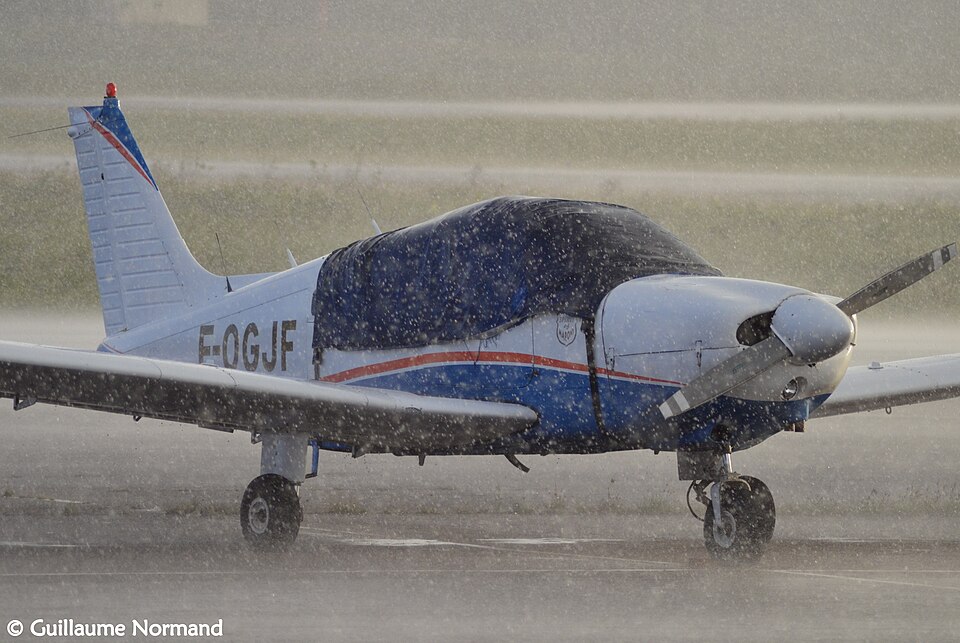
On May 14, 2015, a Piper PA28 (registration F-OGJF) was involved in an aviation accident near Marie-Galante, FR. No fatalities were reported. This summary draws on records from the French Bureau d'Enquêtes et d'Analyses (BEA); 4 related events involving the same aircraft type or operator are linked below.
A Piper PA-28 (F-OGJF) crashed into trees and the ground before the threshold of runway 09 at Marie-Galante on 14 May 2015 during a PPL practical test. The examiner was injured, the candidate slightly injured, and the aircraft heavily damaged.
Flight details and accident sequence On 14 May 2015, a Piper PA-28 registered F-OGJF departed Saint-François (971) at 12:15 local time for a flight to Fort-de-France (972) as part of a practical examination for the Private Pilot Licence (PPL). The candidate sat in the left seat and the examiner in the right seat. After approximately 1 hour 45 minutes of flight, the aircraft was at about 3,000 ft, roughly seven kilometres in line with runway 09 at Marie-Galante. The examiner reduced engine power and asked the candidate to perform a forced-landing exercise on the runway. In short final, the aircraft struck a row of trees about three metres high, located approximately 130 metres before the threshold of runway 09, and then struck the ground. The examiner was injured, the candidate was slightly injured, and the aircraft was heavily damaged. ## Crew and examination background The candidate was 48 years old and had been presented for the PPL practical test by the aéroclub based at Marie-Galante where he had completed his training. His training record showed PPL training begun in July 2011 on a Socata Rallye until April 2015. From 11 May 2015, following unavailability of the Rallye, he completed three series of flights with his usual instructor on a Piper PA-28, including navigations, to familiarise himself with the PA-28 and finish his PPL training. His PPL theoretical aptitude certificate, dated 15 May 2013 with a 24-month validity, expired on 15 May 2015, the day after the event. A request for an exceptional derogation to extend the theoretical certificate deadline had been made by the candidate to the authorities but was not accepted. The examiner was 69 years old and held a professional pilot licence with single-engine piston (SEP) and flight instructor (FI) qualifications. He served as instructor and chief pilot at an aéroclub in Guadeloupe. His logbook showed a total of 7,064 flight hours, including 6,608 hours as pilot-in-command on single-engine aircraft. He usually flew Cessna C172 or C150 aircraft within his aéroclub, and less frequently Piper PA-28. His logbook indicated previous PA-28 flights on 4 and 5 January 2014 (navigation flights as pilot) and 14 March 2014 (PPL aptitude test as examiner). He had completed an examiner refresher course at an Approved Training Organisation (ATO) in metropolitan France in July 2014, and a skills assessment with a pilot-inspector in late October 2014, which allowed him to extend his FE-PPL examiner authorisation for three years until the end of 2017. ## Regulatory and training context The applicable European regulation (AMC1 FCL.235) described the exercises and manoeuvres to be performed during a PPL test on a single-engine aircraft, including simulated engine failures during take-off, descent, approach to landing at reduced power, and simulated forced landing. The regulation specified that the last two exercises could be combined at the examiner’s discretion. Due to the specific environment of the Antilles, where few sites are suitable for performing the simulated forced-landing exercise alone, the reduced-power approach and simulated forced-landing exercises are generally combined. For PPL practical tests, the examiner used the implementation instructions from the safety manual transmitted by the ATO where he had completed his refresher course. Chapter 5 detailed the test exercises, how to simulate them, errors that could lead to critical situations, and safety instructions. It did not contain specific safety instructions regarding the performance of reduced-power approach or simulated forced-landing exercises, nor how to combine the two exercises. ## Meteorological conditions Meteorological information for the day indicated conditions favourable for VFR flight along the intended route. The METAR message at 14:08 from Pointe-à-Pitre Le Raizet aerodrome, located 45 km from Marie-Galante, reported wind from 110° at 12 kt, visibility greater than 10 km, few clouds at 3,300 ft, temperature 30 °C, dew point 19 °C, and QNH 1016. The upper-wind forecast chart indicated easterly winds of 20 kt at FL50 for that period. The wind remained substantially constant throughout the day until it weakened from 18:30 in the evening. ## Flight path and glide performance The planned route included navigation between Saint-François and Fort-de-France. Through the south-east of the island of Dominica, the examiner asked the candidate to divert to Marie-Galante aerodrome by passing west of Dominica. Upon arriving in the vicinity of Marie-Galante, the examiner asked the candidate to perform some manoeuvring exercises. Radar data showed that at the time of power reduction, the aircraft was 8.1 km (3.8 NM) from the threshold of runway 09 at Marie-Galante at an altitude of approximately 2,900 ft. Once the engine was reduced, the trajectory was substantially straight and on a uniform descent approach path. The extension of the trajectory ended before the threshold of runway 09. The average ground speed recorded on the first part of the final approach was 55 kt. Beginning the failure exercise at an altitude of 3,000 ft, the aircraft flight manual indicated a glide distance of approximately 5.4 NM (10 km). This distance was given considering: no wind; maximum mass; reduced engine; flaps retracted; and indicated airspeed of 76 kt (141 km/h), corresponding to the maximum glide speed of the aircraft. According to the flight manual, at the time of power reduction, the Marie-Galante runway was theoretically reachable without wind. The average descent rate recorded on the final approach of F-OGJF according to radar data was approximately 720 ft/min and was therefore consistent with the theoretical glide performance of the aircraft. Assuming that during its final descent the aircraft experienced an average effective headwind of 18 kt, the glide distance was reduced by approximately 1 NM (1.8 km), to 4.4 NM (8.1 km). The Marie-Galante runway was therefore not reachable in glide under these conditions. It is also noted that when the engine power was reduced, the windsock of the aerodrome located more than 5 NM away was not visible to the crew. ## Testimony The candidate stated that after manoeuvring exercises and being in a very long final for runway 09, the examiner asked whether they could reach the runway with reduced engine power. Seeing four white lights on the PAPI at the beginning of the exercise, he thought the exercise was feasible. He specified that during the final approach, he then expressed doubts about the aircraft’s ability to reach the runway in glide, particularly when a PAPI light turned red. The examiner then asked him to continue the exercise and then extend one notch of flaps, before taking over the controls and beginning a go-around just before the aircraft struck the trees. The examiner stated that during a prior telephone contact with the candidate a few days earlier, the candidate had specified that his theoretical aptitude certificate expired on 15 May and that his test had to be performed no later than 14 May. The examiner had agreed to perform the test on that date, after expressing some reservations about the short notice. The examiner explained that he had initially planned to perform this reduced-engine landing exercise