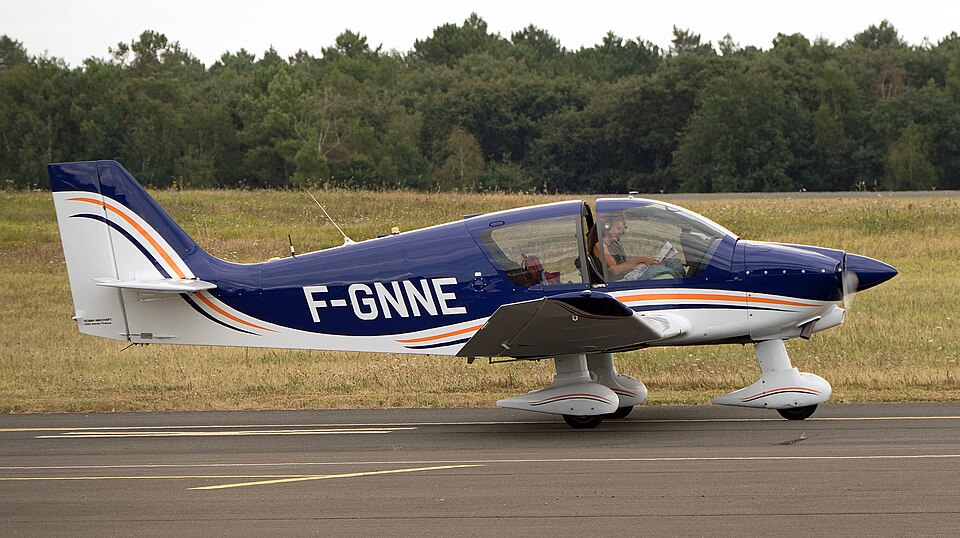
History of the Flight
Three student pilots were conducting a triangular cross-country training flight between Lognes-Émerainville, Le Touquet-Côte d'Opale, and Beauvais-Tillé aerodromes as part of a Private Pilot Licence course. Student pilot A, accompanied by the instructor and two other student pilots in the rear seats, departed Lognes at approximately 09:30. He flew the first leg to Le Touquet, landing around 10:50. Student pilot B then took the controls, departing Le Touquet at about 11:50 for the second leg to Beauvais, landing at approximately 12:30. Student pilot C assumed control and departed Beauvais at around 13:00 for the final leg to Lognes.
At 13:20, the message "Fox November Echo, vertical terrain, 1,500 feet" was transmitted on the Plessis-Belleville aerodrome air-to-air frequency. Shortly thereafter, a bird struck the left wing of the aircraft. The airplane momentarily maintained its flight path before entering a steep left roll and pitching nose-down. F-GNNE collided with the ground in a field near Saint-Pathus (Seine-et-Marne).
Wreckage and Bird Strike Evidence
Examination of the engine and flight controls revealed no anomalies prior to impact. The remains of a great cormorant (Phalacrocorax carbo), weighing 2.4 kg with a wingspan of 1.30 m, were found on the ground in front of the left wing. The bird struck the underside of the plywood overlay on the leading edge of the left wing, at the pitot tube, between ribs 6 and 7. The lower surface fabric tore progressively between ribs N6 and N7 up to the rear false spar. No signs of twisting or abnormal loading were observed on the aileron control cables or the rear wing structure. The main spar did not break in flight.
Meteorological and Airspace Conditions
At 13:30, the METAR for Roissy-Charles de Gaulle airport (18 km from the site) reported wind from 010° at 8 kt, visibility greater than 10 km, few clouds at 3,600 ft, and temperature 12°C. The accident occurred in Class G airspace at an altitude of approximately 1,400 ft. VFR flights in that area were capped at 1,500 ft due to the Paris 2 TMA (Class A) above.
Pilot Information
The 37-year-old instructor held a CPL(A) issued September 2018 and an FI(A) rating from August 2019. He had about 1,200 flight hours, including 1,030 hours as pilot-in-command and 900 hours as instructor, with 91 hours on the DR400 since 1 February 2021. He was the primary instructor for all three student pilots.
Student pilot A, aged 40, started training on 12 January 2020 and had 30 flight hours (26 on the DR400). Student pilot B, aged 30, started on 5 July 2020 with 14 hours (all on the DR400). Student pilot C, aged 20, started on 15 October 2020 with 7.5 hours (all on the DR400).