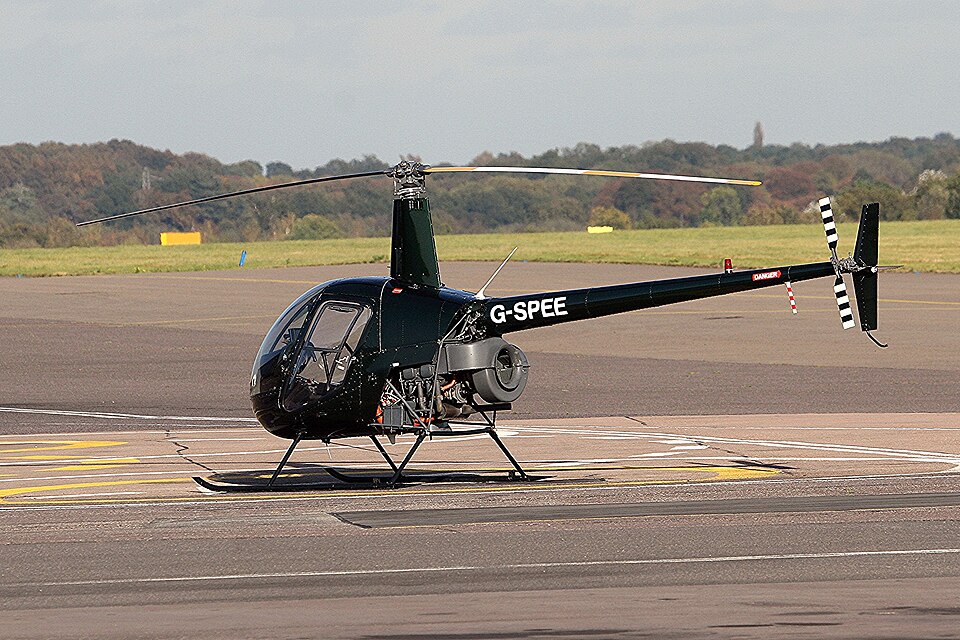
On September 5, 2016, a Robinson R22 Beta (registration G-SPEE) was involved in an aviation accident near Origny-le-Sec, FR. Investigators recorded the probable cause as: The pilot’s decision to take off at night, despite limited recent experience, to reach his destination without the required qualification, from an unapproved aerodrome, in weather incompatible with night VFR; the pilot lost external visual references and… This summary draws on records from the French Bureau d'Enquêtes et d'Analyses (BEA).
A private Robinson R22 Beta (G-SPEE) crashed on 5 September 2016 near Origny-le-Sec, France, killing the pilot. The BEA attributed the accident to a night VFR flight in incompatible weather without proper qualification.
Overview and flight details On 5 September 2016, a Robinson R22 Beta helicopter, registration G-SPEE, was destroyed in a collision with the ground near Origny-le-Sec (10), France. The aircraft was operating a private general-aviation convenience flight. The sole person on board, the pilot, was killed. The helicopter departed Moret-Episy (77) at approximately 21:10 local time for a night visual flight rules (VFR) flight to Reims-Prunay (51). Shortly after takeoff, the pilot contacted Seine Info flight information region to activate the flight plan. At 21:48, the controller asked for an estimated arrival time; the pilot replied “22:30 approximately, I am struggling a bit with the elements” and said he thought he would divert to Vatry. At 21:50, the controller provided the 19:30 UTC METAR for Châlons-Vatry, which the pilot read back. At 21:51, the controller provided the 19:30 UTC METAR for Reims, which the pilot did not read back. At 21:52, radar contact was lost after the helicopter had just completed a turn of more than 360° at an altitude of about 1,500 ft. Shortly afterward, the helicopter struck the ground. No distress message was heard. ## Meteorological conditions A disturbance passed over the region in the evening, bringing a very humid warm sector, low ceilings, and rain or drizzle reducing visibility. Available weather documents included METARs, TAFs, and the 18:00 UTC TEMSI chart. The report notes that it was not possible to determine precisely which weather information the pilot had. During the flight, the controller transmitted the 19:30 UTC METAR for Châlons-Vatry, which the pilot read back. The 19:30 UTC METAR for Reims was transmitted but not read back. ## Pilot experience The pilot held a private helicopter pilot licence since 2014 and had 63 hours of helicopter flight time, including 24 hours as pilot-in-command. His last recorded helicopter flights were 30 minutes in September 2015 and 60 minutes in October 2015. No helicopter night rating appeared in his logbook. He also held a private aeroplane pilot licence since 2011. At his last aeroplane flight in July 2015, he had 212 hours, including 98 as pilot-in-command. His aeroplane night rating was dated March 2011. His last aeroplane night flight was on 14 October 2011, when he had 16 hours of night flight time, including 10 as pilot-in-command. ## Site and wreckage examination The wreckage was found grouped on a large, flat, unobstructed, and very uniform parcel of land. The helicopter was completely destroyed, with debris spread along a south-north axis over about 30 metres. It struck the ground at a 30° nose-down angle with high energy. Data from the helicopter’s integrated GNSS receiver and the pilot’s tablet could not be used. Examination of the wreckage did not reveal any technical failure prior to the collision. ## Testimony The purpose of the flight was to ferry the helicopter by day from Moret to Reims. A witness, one of five co-owners of the helicopter and founder of the “heliclub” shared-ownership association, drove the pilot from Reims to Moret. The journey took longer than expected, and the pilot considered starting the flight by day and finishing it at night. The witness, concerned about weather conditions on the road, suggested returning to Reims. Near Montmort-Lucy (51), between Épernay (51) and Romilly-sur-Seine (10), there were low stratus and drizzle. The pilot checked the weather on a website and said he was convinced the conditions allowed the flight. They continued to Moret. On arrival at Moret, additional fuel and preparation delays led to a night departure. The witness described the pilot as “one of the most qualified pilots in the heliclub due to his experience and skills in night flying in twin-engine and twin-turbine aeroplanes” and said there was “no doubt” in his mind that the pilot was qualified for helicopter night flying. Two other witnesses, also heliclub pilots present at the departure aerodrome, said they tried to dissuade the pilot from taking off and to postpone the flight. One offered to host the pilot, providing an alternative to the inconvenience of a late cancellation. A member of the association said the pilot intended to resume helicopter flying at Reims after a ten-month interruption. His helicopter instructor described him as a “flexible, gentle, gifted and attentive pilot with a tendency toward overconfidence.” ## Radar and audio data Radar recordings showed that from takeoff, the helicopter followed an eastward, sometimes southward, trajectory, with numerous turns, one exceeding 360 degrees. Flight altitude was not constant and sometimes below regulatory standards. These manoeuvres, along with radio exchanges with the flight information region, indicated the pilot likely encountered difficulties maintaining conditions compatible with a night VFR flight. ## Departure aerodrome Moret-Episy is an aerodrome open to public air traffic but not approved for night VFR. ## Findings and conclusion The pilot was not qualified for night VFR in a helicopter and had not flown a helicopter for ten months. Analysis of the weather situation along the route at the time of the departure decision allowed anticipation of the deteriorating conditions the pilot encountered. The accident was caused by the pilot’s decision to take off at night, despite limited recent experience, to reach his destination without the required qualification, from an unapproved aerodrome, in weather incompatible with night VFR. The pilot lost external visual references and collided with the ground.
Probable cause
The pilot’s decision to take off at night, despite limited recent experience, to reach his destination without the required qualification, from an unapproved aerodrome, in weather incompatible with night VFR; the pilot lost external visual references and collided with the ground.