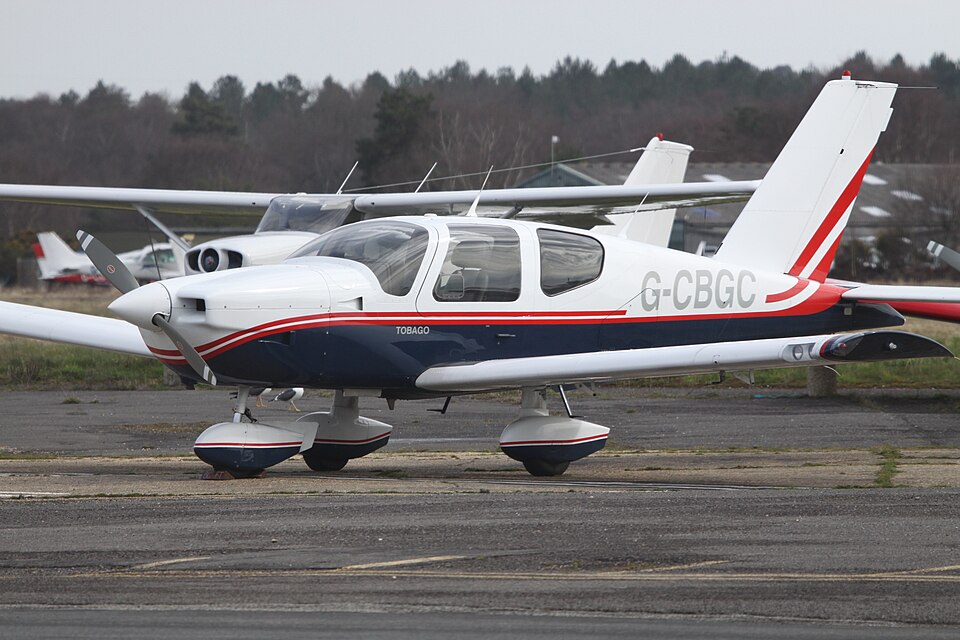
History of the Flight
On the accident evening, a pilot in training planned to execute five runway circuits at Cannes-Mandelieu to qualify for a night VFR rating. Aeronautical night had begun at 17:50. At 18:17, the pilot, accompanied by his instructor, departed from runway 35. They performed a touch-and-go landing followed by a full-stop landing at 18:34. The instructor then decided the pilot could proceed with solo circuits.
The pilot took off at 18:46 and completed four circuits, each ending in a full-stop landing. At 19:36, he departed for a final circuit. Three minutes later, while on the downwind leg, he informed the airport controller he would call back on final for runway 35. At 19:40, the pilot initiated a right turn to join the base leg. The aircraft's altitude suddenly decreased and its radar track disappeared. The airplane collided with the water surface about 2 NM from the threshold of runway 35. The tower controller repeatedly called the pilot but received no response, then alerted emergency services.
Pilot Experience
The 60-year-old pilot held a Private Pilot Licence (Aeroplanes) with a Single-Engine Piston (land) rating. He had logged approximately 153 flight hours, including six hours on the SOCATA TB10, all within the previous three months. He obtained his PPL(A) in January 2020 after three years of training and 143 flight hours on the DR400 120 and the Aero AT-3.
The pilot began theoretical and practical night VFR training at Cannes on 13 February 2020. During training, he logged 4 hours 10 minutes in dual flight: 1 hour 10 minutes with three landings on a PA28, and 3 hours with 14 landings on the TB10. He had executed five circuits for runway 35 at Cannes on the TB10 under instruction, without a natural horizon over the sea. This training was paused in March 2020 due to the COVID-19 pandemic.
The pilot resumed flying on 8 September 2020, exclusively on the TB10. He was authorized to fly solo on the TB10 on 18 October 2020 after five hours of dual instruction. On the accident date, he was scheduled to fly five solo night circuits with full-stop landings, required for the night rating.
Meteorological Conditions
Weather was light wind, visibility greater than 10 km, scattered clouds at 1,500 ft, overcast at 3,500 ft, temporarily overcast at 1,400 ft, temperature 17 °C, dew point 15 °C, QNH 1023 hPa, and no haze. Satellite imagery at 19:40 showed low-level clouds with a base at 3,500 ft between Cannes airport and the Lérins Islands, and lower clouds with a base at 1,500 ft moving from west to east about 5 km south of the Lérins Islands. The moon was full.
A DA40 pilot in flight at the time had initially a clear view of the sea due to moon reflection, but later the night became very dark, obscuring the horizon, and he felt "being in a void." He relied on instruments. He performed his final landing at 19:12. He reported no wind and a very calm air mass.
Wreckage Examination
Parts of the aircraft were found floating near the accident site. Examination indicated high energy impact with the sea. The Maritime Prefecture and French Navy located the wreckage at a depth of 335 m off Cannes airport. Underwater examination was difficult due to steep gradients up to 60% and poor visibility, which worsened when the remotely operated vehicle (ROV) disturbed sediment. Numerous photographs were taken and studied in real time and later with the manufacturer. The wreckage dispersion and embedding in the sea floor prevented recovery. No evidence was found to explain the accident.
Instructor Statement
The instructor, also an examiner who had awarded the pilot his PPL(A), stated that the pilot demonstrated a very good theoretical and practical level during the test flight. After the test, the pilot expressed interest in night flying on the TB10, and the instructor oversaw his night VFR training. The program was nearly complete when training stopped in March 2020. The pilot resumed contact in August 2020. After obtaining a Variable Pitch rating, the date of 2 November 2020 was set for the five solo night circuits.
On the accident day, the instructor accompanied the pilot in dual for night circuits. He recalled suitable weather: calm wind, good visibility, with landmarks clearly visible, but dark out to sea and clouds obscuring the moon. After the second dual circuit, the instructor deemed the pilot ready for solo flights. On the ground, he briefed the pilot that each circuit must end with a full-stop landing. He observed the first four solo landings and considered them performed very well.