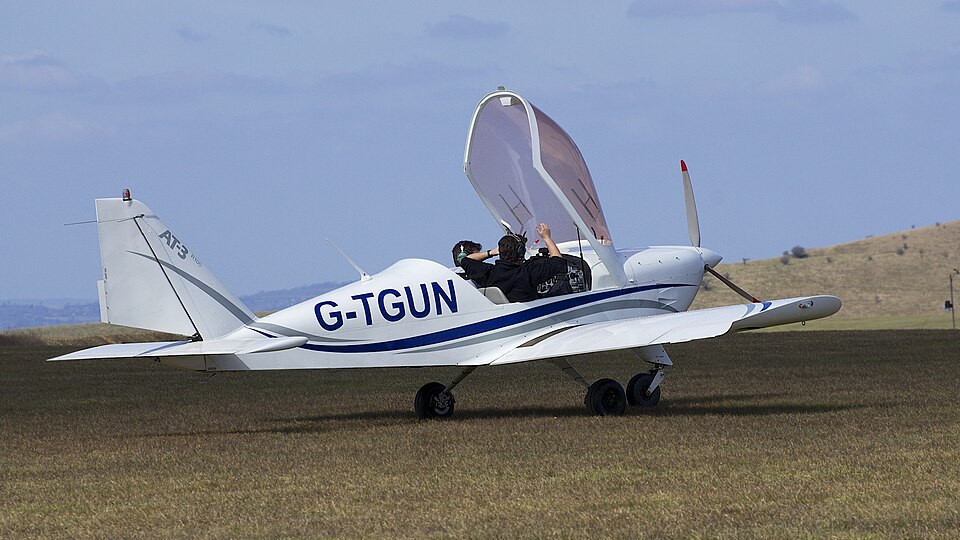
Incident Description
On 12 June 2009 at 1640 UTC, a private flight in G-TGUN, an Aero AT-3 R100 (single-engine Rotax 912-S2, 2008 year of manufacture), at Old Sarum Airfield, Wiltshire, ended with a collision. After an uneventful flight, the pilot taxied to the fuel bowser, shut down the engine and electrics, and left the parking brake lever in the off position. After refueling with 10 litres of fuel, the pilot and passenger reboarded, closed the canopy, turned on the battery and generator, applied pressure to the toe brakes, set the throttle lever to ¼", called "clear prop", and turned the ignition key to start. The engine started, and the aircraft moved forward and turned sharply left. The pilot continued to apply pressure to the toe brakes, but they did not work. After the aircraft turned left through approximately 160°, the propeller struck the fuel bowser, followed by the right wing. The engine stopped as a result of the propeller strike, and the aircraft came to rest. The passenger vacated first, followed by the pilot after turning off the switches. No injuries were reported. The parking brake lever was later found in the upright (on) position.
Braking System Details
The Aero AT-3 has a hydraulic braking system operating disk brakes on each main wheel via toe pressure on the rudder pedals. A parking brake lever, fitted to G-TGUN, is located on the right side of the pilot's footwell. The lever is off when horizontal and on when vertical. To set the parking brake, the pilot must apply toe brake pressure before moving the lever, as the lever works by trapping hydraulic pressure in the brake lines. The parking brake lever can be moved to the on position without hydraulic pressure and will stay there, but the parking brake is not applied in that case. Early versions of the parking brake valve incorporated a bypass valve that allowed toe brakes to function even with the lever on, but G-TGUN was fitted with a later valve without a bypass. Therefore, on G-TGUN, if the parking brake lever was in the on position, the toe brakes had no effect.
A CAA test pilot evaluated G-TGUN's braking system. He determined that the parking brake operated satisfactorily when the lever was moved to on while applying foot pressure. However, it was possible to inadvertently select the lever to on (e.g., by foot or clothing contact when exiting the aircraft), trapping zero foot pressure and rendering the toe brakes inoperative. The test pilot noted that this condition did not meet the intention of CS-VLA 1301 and considered that pilots may reasonably expect toe brakes to be available at all times. His report recommended redesign.
Flight Manual and Checklists
The Flight Manual for G-TGUN (September 2004 version) contained a description of the braking system, but the accompanying diagram depicted a different brake system version, giving an incorrect impression that the parking brake could be applied from the right-seat pedals. The manual did not inform that the toe brakes would be inoperative when the parking brake lever was on. The checklist in the Flight Manual did not contain references to the parking brake. The UK supplier had provided a modified checklist in September 2008 calling for the parking brake to be set on before walk-around and selected off before engine start. The flying school that operated G-TGUN created its own checklist, which initially led to a previous incident due to leaked trapped pressure. Following that, the school revised its checklist and training to start the engine with the parking brake off and toe brakes held. The pilot of G-TGUN was using this revised checklist, which included a check that the parking brake lever was off prior to walk-around and to hold toe brakes during engine start. After the G-TGUN incident, the flying school added a second "Parking Brake – Horizontal (Off)" check at the beginning of the engine start section.
Regulations
CS-VLA 1309 requires that equipment, systems, and installations be designed to minimize hazards in the event of a probable malfunction or failure. CS-VLA 1301 requires each installed item to function properly when installed. CS-VLA 777 requires cockpit controls to be located to prevent inadvertent operation. The AAIB made three Safety Recommendations addressing the parking brake system design and the information provided to pilots about its limitations.