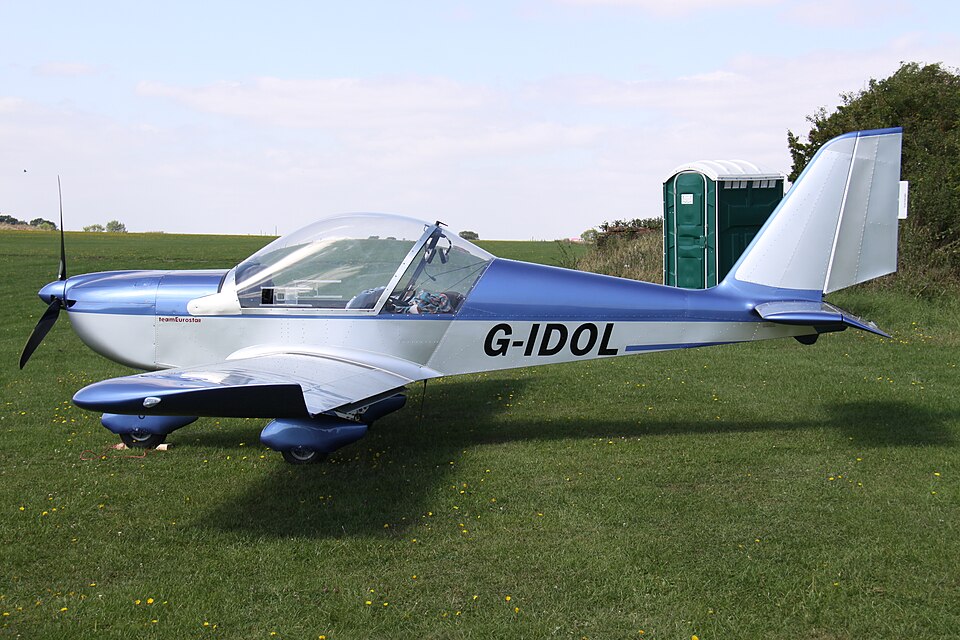
Accident
On 9 April 2011, at approximately 1230 UTC, an Aerotechnik EV-97 Eurostar, registration G-IDOL, was conducting a private flight from Damyns Hall Airfield, Essex. The pilot, aged 65 with 217 flight hours (157 on type), was the sole occupant. During the takeoff roll on Runway 14, the nosewheel struck a bump on the runway surface, causing the aircraft to lift off prematurely at a low airspeed. The engine torque and propeller slipstream effects, combined with a crosswind component, caused the aircraft to turn left. The pilot applied right rudder but was unable to correct the heading. He then closed the throttle and applied brakes, but the aircraft continued left toward a row of parked cars. To avoid the vehicles, the pilot applied full left rudder, turning the aircraft almost 180 degrees from the takeoff direction. The open tailgate of the last car allowed the right wing tip to contact the inside of the C-pillar, swinging the aircraft right and colliding with the side of the car. The pilot was not injured; damage included the propeller, wings, fuselage, left landing gear, fin, nosewheel fairing, engine shock-loading, and damage to a parked car.
Pilot Experience and Wind Conditions
The pilot held a National Private Pilot's Licence and had flown 7 hours in the last 90 days, 3 hours in the last 28 days. He reported the wind at the time as 110 degrees at 12 knots, approximately 30 degrees left of the runway heading, exacerbating the aircraft's left-turning tendency.
Flight Test and Investigation
Following the accident, the Light Aircraft Association (LAA) conducted a flight test on a similar EV-97 Eurostar example to evaluate its handling characteristics against CS-VLA standards. The test was flown solo, half fuel, no baggage, with mid center of gravity and left-lateral CG displacement. At full power, the aircraft required increasing right rudder as airspeed decreased, reaching full deflection at 40-42 mph IAS (power-off stall speed). Rudder response was linear with no stall. Yaw control remained effective up to maximum slip indicator amplitude. Tests with takeoff and landing flaps showed no significant change in control characteristics except lower stall speeds. Takeoff behavior on a hard runway in nil wind with 45 mph rotation speed showed no directional difficulties and no tendency to be 'hauled off' the ground at speeds below 45 mph. The flight test noted that the aircraft accelerates quickly between 30 and 60 mph on takeoff, and suggested avoiding attempts to fly out of a bounce or premature takeoff below 45 mph IAS; instead, allowing the aircraft to sink back onto the runway for acceleration.
Related Incident
A similar crosswind-related incident occurred to another EV-97 Eurostar, G-CFVI, at Peterborough on 3 April 2010, as reported in AAIB Bulletin 9/2010.